OptiCore Pro Capsules: Official Website for Screen-Time Eye Comfort
OptiCore Pro is a once-a-day dietary supplement capsule for eye comfort through long hours on screens and close work.
Use case: Screen users and close-work adults take one capsule a day with water ahead of a meal. Each bottle is a 30-day supply.
How it works: Vitamin C and magnesium at 60 mg each, zinc at 3.62 mg and 13 more nutrients sit beside a 179.5 mg blend of 11 botanicals.
Below: every printed amount set against the eye trials, the two things the seller says it is for, the three packs and their cost a day, what buyers report, and where the 180-day window falls on the calendar.
Free US shipping on 3 & 6 bottles Paid once, nothing renews 180-day money-back guarantee
- One capsule a day
- 30 capsules a bottle
- 16 nutrients with printed amounts
- 3–4 weeks typical wait
- 180-day guarantee
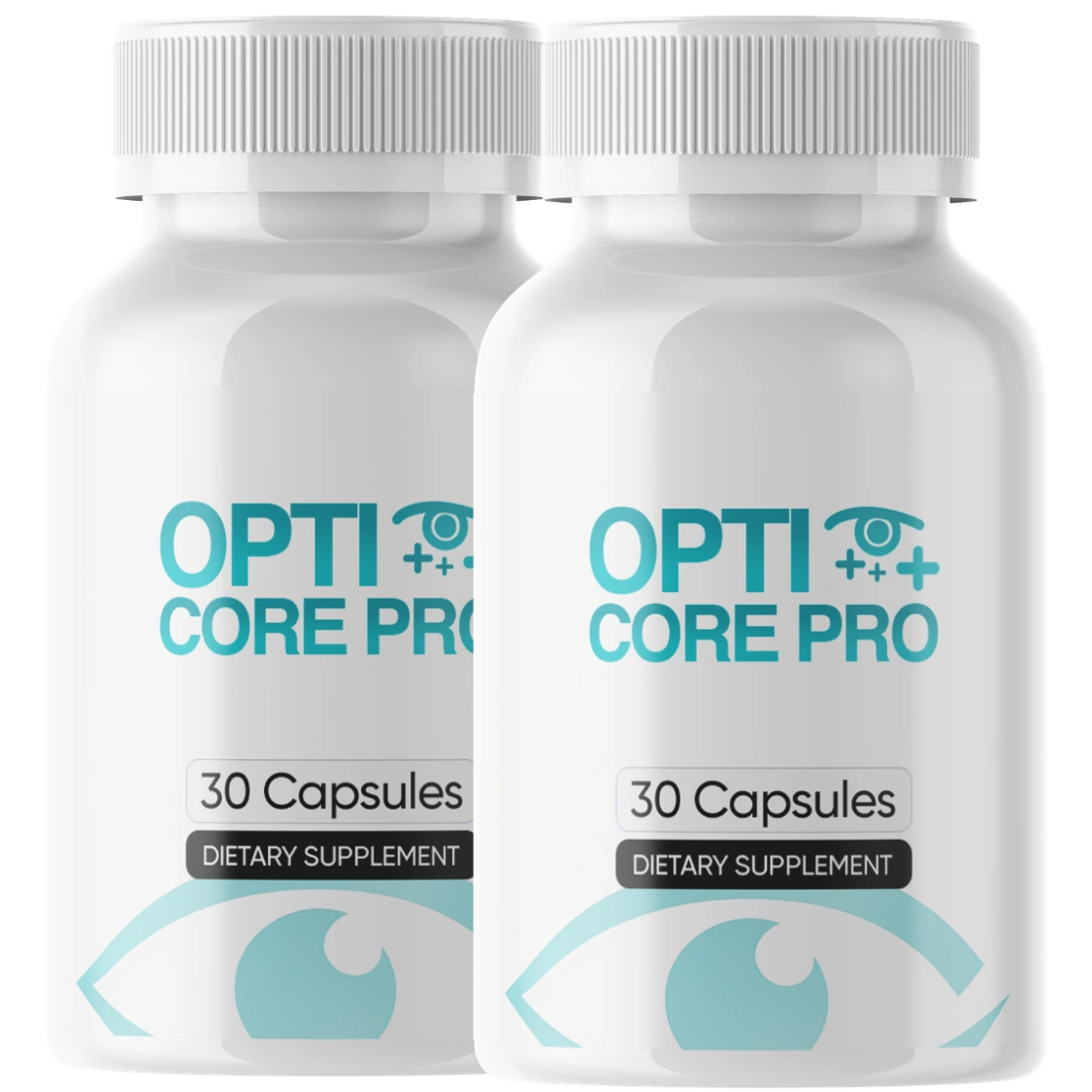
Lot OPT-26/TH-5176 · 30 capsules · one a day
OptiCore Pro label facts: the bottle in six lines
OptiCore Pro is a vegetable capsule taken once a day, 30 to a bottle. It declares 16 nutrients, each with an amount and a Daily Value, and a 179.5 mg blend of 11 botanicals. Vitamin C and magnesium, at 60 mg each, are the largest single figures.
The six lines most buyers want first.
| What the bottle prints | Detail |
|---|---|
| Form | A vegetable capsule. The dose is one, and thirty in the bottle covers a calendar month. |
| Serving | One capsule with an 8 oz glass of water, 20 to 30 minutes before a meal. |
| Declared nutrients | 16, each with an amount and a % Daily Value. Vitamin C at 60 mg and magnesium at 60 mg are the largest single figures on the panel. |
| The blend | A 179.5 mg proprietary blend of 11 botanicals, with one total for all eleven and no figure for any single one. |
| What the seller says it is for | Everyday vision wellness, and eye comfort and strain from screens and demanding close work. The bottle itself carries no such line. |
| Price and guarantee | Between $49 and $79 a bottle, set by how many you take. The 180-day refund clock starts the day the order is paid for. |
Every line above came off the printed label or a seller package card, read on 19 September 2026.
Why do screen users look for a vision supplement like OptiCore Pro?
People look at a vision supplement like OptiCore Pro after long days at a screen, when the eyes feel dry, heavy and slow to change focus. OptiCore Pro is one capsule a day, sold for eye comfort during screen and close work.
What sends someone looking, and what the evidence says helps most.
The trigger is usually a working day rather than an eye problem. Eight or nine hours at a screen, an hour more on a phone, and by the evening the eyes feel dry, heavy and slow to change focus. Reading small print takes a second longer than it used to.
That cluster has a name, digital eye strain, and a 2026 review of it describes a condition of the ocular surface and of the focusing system rather than of the retina. Blink rate falls at a screen, the tear film thins, and the muscles that hold a near focus stay contracted for hours at a time.
The measures with the best evidence behind them are behavioural and free. The American Academy of Ophthalmology sets them out: breaks, distance, lighting, blinking, and a current spectacle prescription. A 2023 trial of the 20-20-20 rule tested the most quoted of them and found measurable benefit for symptoms and for the tear film, while a companion paper points out that the twenty-second and twenty-foot figures were never derived from data at all.
A capsule sits alongside that rather than instead of it. What people are usually after when they buy one is the nutritional half of the picture, and a routine simple enough to keep. Both are fair things to want, and both are what this seller’s page offers.
What is OptiCore Pro?
OptiCore Pro is a once-a-day capsule sold for everyday vision wellness and eye comfort, 30 capsules to a bottle. The panel prints 16 nutrients with an amount for each, plus a 179.5 mg blend of 11 botanicals. Every figure here comes from the label.
The short version, and where every figure on this site comes from.
OptiCore Pro arrives as a 30-capsule bottle taken one capsule at a time, so a bottle runs a calendar month at the printed dose. The front of the bottle reads “OPTI CORE PRO” over an eye device, with “30 Capsules” and “Dietary Supplement” beneath it. The seller’s own sales page sets the name as three words, Opti Core Pro.
The panel carries 16 declared nutrients: eight vitamins, one B vitamin group, folate and biotin among them, plus six minerals. Every one has its own line, its own amount and its own % Daily Value. Beneath them sits a 179.5 mg proprietary blend naming 11 botanicals.
This website is the U.S. stocking partner for it. The bottle is distributed by Opti Core Pro, PO Box 12730, Ogden, UT 84404, which is a different desk with a different telephone number, and neither is the manufacturer: the label says only that it was made in the USA with globally sourced ingredients.
One thing is worth knowing before anything else on this page. The seller’s sales page names no ingredient in its text at all, while the bottle prints a complete panel. Everything here is built from the panel, which is the list that arrives in the box.
Why buy OptiCore Pro from the official website?
Buy OptiCore Pro on the official website to get the 180-day money-back guarantee, which runs from purchase and covers orders placed here. Three and six bottle orders ship free inside the US, and you pay once with nothing that renews.
Six of them, and every one is about what happens after you pay.
The refund window follows the desk, not the bottle
That 180-day window is written by this desk and the seller standing behind it. Buy the same bottle from a marketplace reseller and you fall under that reseller's terms instead, whatever those turn out to be.
Shipping costs nothing on the larger two packs
Nothing is added to a three or six-bottle order inside the United States. The two-bottle card carries a $9.99 shipping note, and the checkout for that same pack showed the line at zero on the day this desk read it, so check the total before you confirm.
You pay once and that is the end of it
A pack is a single purchase with no renewal behind it, so there is no subscription to remember and nothing to cancel. That is the objection people raise most often about anything sold this way, and it does not apply here.
The return address gets confirmed before you post
Worth knowing here more than on most desks. The seller's refund policy and the bottle both give a PO Box in Ogden, Utah, while this desk's paperwork gives an address in New York. Call the order desk first and get the right one in writing. The refund page has the steps.
Every bottle carries a lot you can quote
Stock leaving this desk is lot OPT-26/TH-5176, filed under certificate reference OPT-5176-26-TH. Both are paperwork identifiers rather than a laboratory result on the capsule, and the batch page says so in as many words.
The whole panel is printed on this site
All 16 rows, the blend total and the other-ingredients line are reproduced on the supplement facts page. Check this page against the bottle when it lands; neither one deserves to be taken on trust.
How does OptiCore Pro work?
OptiCore Pro stacks three arguments in one capsule, and only one is strong. The nutrient-adequacy idea behind the vitamins and minerals is the oldest and most defensible. The other two have far less behind them, and no trial exists for the finished capsule.
Three arguments, and only one of them is strong.
The panel is really three arguments stacked together, and they do not carry equal weight, so this page takes them one at a time.
The nutrient-adequacy idea: the vitamins and minerals
The oldest and the most defensible of the three. Vitamins A, C, E, the B group and zinc all have roles in the tissues of the eye, and a shortfall in any of them shows up in how those tissues behave. That is a statement about adequacy rather than about improvement: topping up a nutrient somebody already has enough of is not expected to change anything. NCCIH puts the same point plainly for supplements in general.
The antioxidant idea: vitamins C and E, beta-carotene and zinc
This is the family the eye-supplement category was built on, and it has exactly two landmark trials behind it. AREDS combined vitamin C, vitamin E, beta-carotene, zinc and copper at high doses, and AREDS2 revised the mix. Both were run in people with established macular disease, at amounts this label does not approach, and the dosage section below sets the two columns side by side.
The botanical idea: the eleven-ingredient blend
The 179.5 mg blend is the part of the panel with the least behind it. Of the eleven plants named, none has a published trial measuring a vision outcome. Several have trials measuring something else entirely: nettle root has prostate work, saw palmetto has hair work, and plant sterols have cholesterol work. They are on this panel on the strength of a general antioxidant argument.
None of them is a mechanism for restoring sight, changing a prescription or treating an eye disease. A supplement in this category supports everyday wellness. Sight itself changes for clinical reasons and is answered clinically, and nothing in this bottle belongs to that conversation.
What are the ingredients in OptiCore Pro?
OptiCore Pro prints 16 nutrients with an amount for each, led by vitamin C and magnesium at 60 mg each, zinc at 3.62 mg and biotin at 2,500 mcg. A 179.5 mg botanical blend has no single amounts. The shell is hypromellose, and the formula contains soy.
What the panel names, and what each one has actually been tested for.
16 declared nutrients, each with its amount printed, and a 179.5 mg blend of 11 botanicals beneath them. Below, what the larger ones are and what the published research on each actually measured.
Vitamin C
as ascorbic acid60 mg (66.5% DV)The largest vitamin figure on the panel and a genuine nutrient for connective tissue and for the lens. It is also the one ingredient here that appears in both landmark eye trials, which is why the amount is worth knowing: AREDS used 500 mg a day and AREDS2 kept it. At 60 mg this is a dietary top-up rather than a trial dose, and 60 mg is roughly what a large orange supplies.
Zinc
as zinc oxide3.62 mg (33% DV)The mineral with the strongest claim to an eye role, because it is concentrated in the retina and is the ingredient AREDS singled out. The trial's own zinc analysis ran at 80 mg a day. AREDS2 later tested 25 mg against 80 mg and found the lower amount performed as well, which is the more useful comparison for a label like this one. Note also why those trials added copper: sustained high-dose zinc depletes it, an effect that does not arise at 3.62 mg.
Biotin
2,500 mcg (8,333.5% DV)The largest number on the whole panel by a wide margin, and the one that says most about what this formula was built from. Biotin at this amount is the standard dose in hair and nail capsules; the review of biotin for hair covers what that literature does and does not show. There is no eye trial of biotin at any dose. The practical point is a laboratory one: a 2025 survey of routine immunoassays sets out how much interference biotin supplements cause, with published cases of a skewed thyroid panel and a distorted troponin result. Tell the laboratory before a blood test.
Magnesium
as magnesium oxide60 mg (14.5% DV)Tied with vitamin C for the largest single amount on the panel. Magnesium oxide is the cheapest and the least absorbable of the common salts: a head-to-head comparison of magnesium salts is the reason the form matters as much as the milligrams. There is no eye trial of magnesium.
Potassium
as potassium gluconate47 mg (1% DV)A row worth reading carefully rather than skipping. Forty-seven milligrams is one per cent of the Daily Value, which is about the potassium in a single strawberry. It is on the panel as a nutrient row rather than as a meaningful source.
Vitamin A
as beta-carotene60 mcg RAE (6.5% DV)Beta-carotene is the form the body converts as it needs it, which is why supplemental beta-carotene does not carry the liver risk that preformed retinol does; a 2025 review of vitamin A and the liver covers that distinction. The AREDS formula used 15 mg of beta-carotene, and AREDS2 removed it after the ATBC and CARET trials found higher lung cancer rates in smokers taking it at high doses. At 60 mcg RAE this label is nowhere near those amounts.
Vitamin E
as DL-alpha tocopheryl acetate7 mg (46.5% DV)The synthetic form, which is the same family AREDS used at 400 IU a day. Seven milligrams is a fraction of that. The compound's own large-trial history is mostly about other organs: SELECT gave 400 IU to 35,533 men and found a significant increase in prostate cancer risk, at a dose forty times this one.
Thiamin, vitamin B6, folate and vitamin B12
the B group3 mg, 4 mg, 748 mcg DFE, 6 mcgFour rows that sit well above their Daily Values, and the honest basis for them is energy metabolism and nerve function rather than vision. A study of blood thiamine in diabetic retinopathy is the nearest the group comes to an eye outcome, and it is an association in a specific disease rather than a trial in healthy eyes. The Women's Antioxidant and Folic Acid Cardiovascular Study is the largest randomised test of this exact combination and measured cardiovascular endpoints. On safety, the review of pyridoxine toxicity is the one to read: 4 mg is a long way below the doses associated with sensory neuropathy, but the mechanism is worth knowing if you take B6 from more than one product.
Iron, calcium and manganese
the remaining minerals7.25 mg, 40 mg, 2 mgThree rows that are unusual in an eye formula. Iron at 7.25 mg is 40.5% of the Daily Value in a product most buyers will take for months, and a population study of serum ferritin and macular disease is the reason iron in this category attracts attention at all. Calcium is at 3% of its Daily Value; AREDS Report 39 examined calcium supplementation and eye outcomes directly. Manganese at 2 mg is 87% of its Daily Value, and a 2025 review of manganese neurotoxicity is the context for adding it up across products.
The 179.5 mg proprietary blend
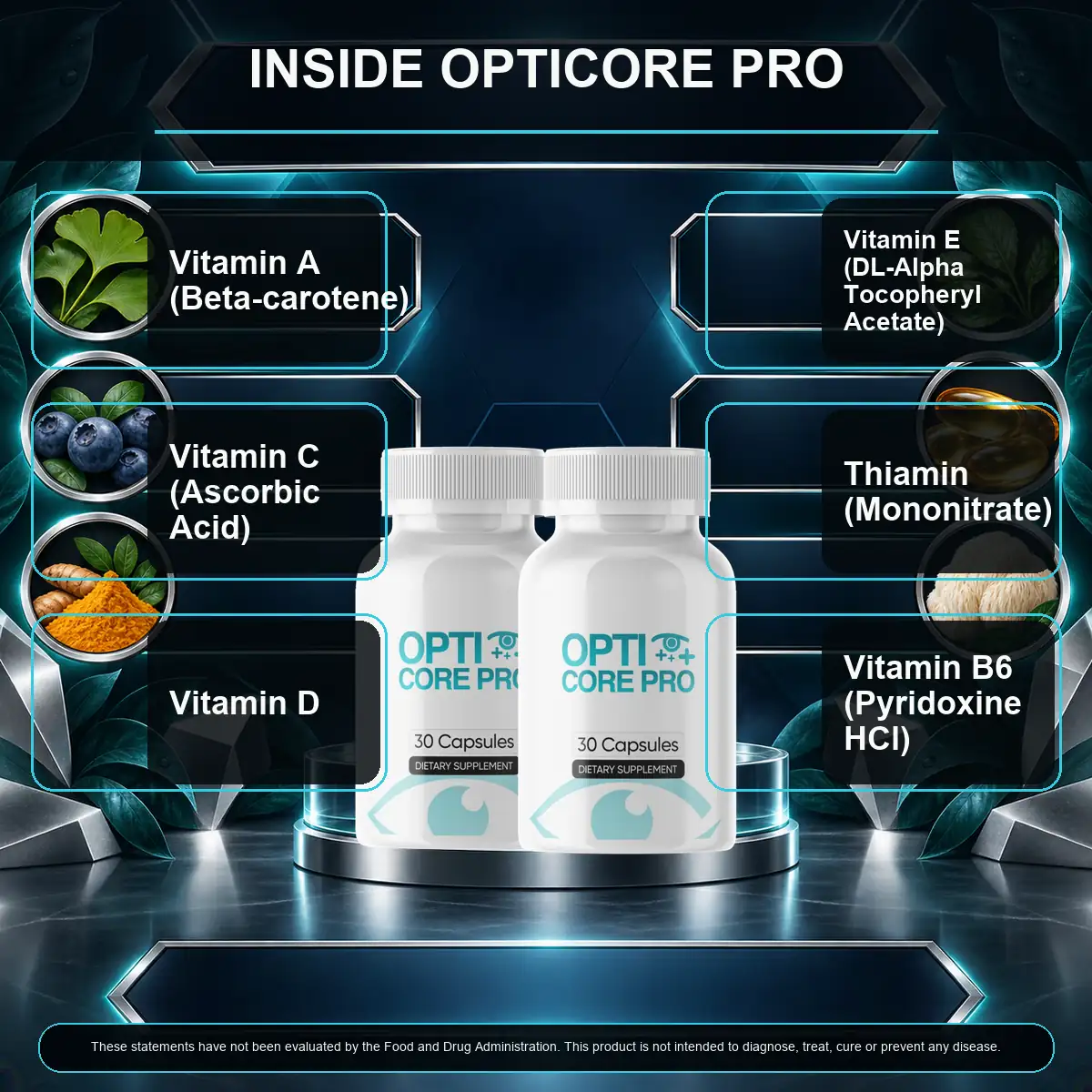
11 botanicals179.5 mg totalPABA, horsetail, Fo-Ti, bamboo leaf, stinging nettle, Chinese peony, spirulina, saw palmetto, plant sterols from soy, alfalfa and barley grass. One total covers all eleven, so the largest any single one can be is 179.5 mg and the smallest is anything at all. Two of them, Fo-Ti and PABA, have published liver-injury reports behind them, which is worth a look at the side effects page. None of the eleven has a trial measuring a vision outcome, and no trial of bamboo leaf or of barley grass in people came back from a PubMed search for this site at all.
Beneath the panel the label prints rice flour, hypromellose (vegetable capsule), magnesium stearate (vegetable), silicon dioxide, followed by “Contains: Soy”. Two things follow. The shell is hypromellose, so it is a vegetable capsule rather than gelatin. And the soy is not a trace: the blend itself carries plant sterols from soy bean, so anyone avoiding soy should treat this product as unsuitable.
OptiCore Pro Supplement Facts: what the label prints
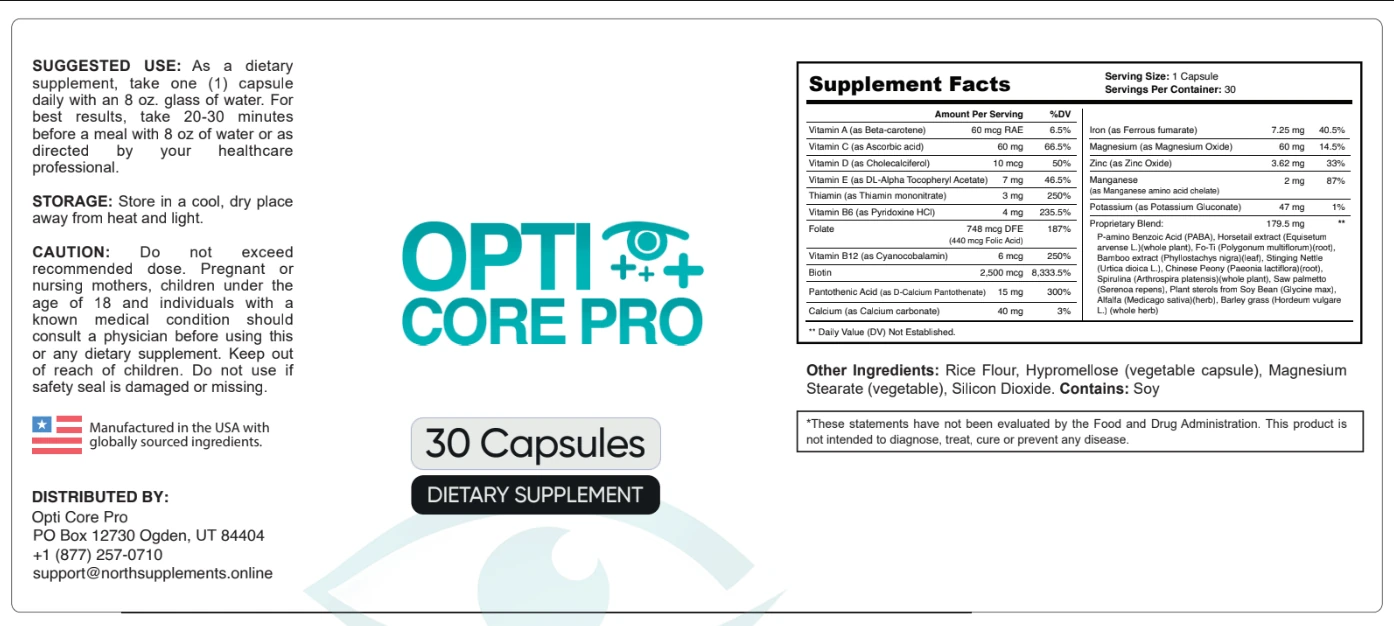
The OptiCore Pro Supplement Facts panel shows every row as the bottle prints it: one capsule per serving, 30 servings per container, 16 nutrients with amounts and Daily Values, and one 179.5 mg proprietary blend of 11 botanicals.
Every row exactly as the bottle prints it.
| Row | Amount per serving | % Daily Value |
|---|---|---|
| Vitamin A (as Beta-carotene) | 60 mcg RAE | 6.5% |
| Vitamin C (as Ascorbic acid) | 60 mg | 66.5% |
| Vitamin D (as Cholecalciferol) | 10 mcg | 50% |
| Vitamin E (as DL-Alpha Tocopheryl Acetate) | 7 mg | 46.5% |
| Thiamin (as Thiamin mononitrate) | 3 mg | 250% |
| Vitamin B6 (as Pyridoxine HCl) | 4 mg | 235.5% |
| Folate (440 mcg Folic Acid) | 748 mcg DFE | 187% |
| Vitamin B12 (as Cyanocobalamin) | 6 mcg | 250% |
| Biotin | 2,500 mcg | 8,333.5% |
| Pantothenic Acid (as D-Calcium Pantothenate) | 15 mg | 300% |
| Calcium (as Calcium carbonate) | 40 mg | 3% |
| Iron (as Ferrous fumarate) | 7.25 mg | 40.5% |
| Magnesium (as Magnesium Oxide) | 60 mg | 14.5% |
| Zinc (as Zinc Oxide) | 3.62 mg | 33% |
| Manganese (as Manganese amino acid chelate) | 2 mg | 87% |
| Potassium (as Potassium Gluconate) | 47 mg | 1% |
| Proprietary Blend | 179.5 mg | † |
Serving size 1 capsule. Servings per container 30. † marks a row for which no Daily Value has been established.
Proprietary blend, in the order the label lists it: P-amino Benzoic Acid (PABA), Horsetail extract (Equisetum arvense L., whole plant), Fo-Ti (Polygonum multiflorum, root), Bamboo extract (Phyllostachys nigra, leaf), Stinging Nettle (Urtica dioica L.), Chinese Peony (Paeonia lactiflora, root), Spirulina (Arthrospira platensis, whole plant), Saw palmetto (Serenoa repens), Plant sterols from Soy Bean (Glycine max), Alfalfa (Medicago sativa, herb), Barley grass (Hordeum vulgare L., whole herb).
Other ingredients: rice flour, hypromellose (vegetable capsule), magnesium stearate (vegetable), silicon dioxide. Contains: Soy.
The artwork in this website’s asset folder was compared byte for byte against the label image the seller publishes on its own sales page. Same frame, same 1394 by 626 pixels, differences only from recompression. Every % Daily Value on it was then recomputed against the current FDA Daily Values and every one agrees, which is why this desk treats it as the real panel and builds the whole site from it.
How is OptiCore Pro dosed?
OptiCore Pro's amounts sit far below the two formulations shown to move a vision outcome in the large National Eye Institute trials. Its vitamin C is 60 mg and its zinc 3.62 mg, and lutein, zeaxanthin and copper are not on the label.
Sixteen printed amounts, set against the only two formulations shown to move a vision outcome.
Everything above is what the capsule contains. What follows is how those amounts stand against the doses the two eye trials ran, which is the only comparison that tells a buyer whether this panel is a version of AREDS at all.
There are only two formulations in the whole literature that changed a vision outcome, and both are public to the milligram. The National Eye Institute publishes them ingredient by ingredient, which makes the comparison below possible at all.
The table says four things at once, and they do not agree with each other.
The amounts that overlap with the eye trials are a fraction of them. Vitamin C at 60 mg against 500 mg, vitamin E at 7 mg against 400 IU, zinc at 3.62 mg against 80 mg. Those are dietary top-ups, and they should be read as nutrient rows rather than as a version of the AREDS formula at a lower strength.
The three ingredients AREDS2 is known for are absent. Lutein, zeaxanthin and copper are the substance of the modern formulation, and none of the three is on this panel. The meta-analysis of macular pigment response and a 2024 trial in long-term screen users are where the lutein and zeaxanthin evidence sits, and the omega-3 pair that AREDS2 also tested is not here either, though that arm showed no added benefit and the dry-eye meta-analysis is a separate question from macular pigment.
The largest number on the panel belongs to a different category. Biotin at 2,500 mcg, 8,333.5% of its Daily Value, sits alongside PABA, horsetail, bamboo leaf, Fo-Ti, nettle, saw palmetto and plant sterols. That is the contents list of a hair and nails capsule. It is a fair description of this formula and it is stated once, here.
And the blend is smaller than any single plant in it was tested at. 179.5 mg split 11 ways is less than the 320 mg of saw palmetto, or the 450 mg of nettle root, that the trials of those two plants used on their own. Whatever the blend is doing, it is not reproducing any of those studies.
The 2023 review on slowing progression found the AREDS-type formulation does slow progression in people who already have intermediate macular disease. The companion review on prevention found no evidence that antioxidant supplements prevent the disease starting in people who do not have it. Both conclusions are about the AREDS doses, in people selected for the trials, and neither transfers to a general wellness capsule at a fraction of those amounts.
Biotin at 2,500 mcg is the one figure here with a practical consequence attached, and it is not a toxicity one. It interferes with common laboratory immunoassays. If you have a blood test booked, say what you are taking, and follow whatever the laboratory tells you about stopping beforehand.
What are the benefits of OptiCore Pro?
The OptiCore Pro bottle carries no benefit line. The seller sells it for two things, everyday vision wellness and eye comfort during screen and close work. Everything beyond that comes from the seller's page, not the label.
The two things the seller says it is for, and what sits behind each.
Start with what the bottle itself says, because it is less than most people expect. The printed label carries a wordmark, a capsule count, the words dietary supplement, a suggested use, a storage line, a caution, a distributor block, the panel, the other ingredients and the FDA disclaimer. There is no benefit line on it anywhere.
Everything this product is sold for therefore comes from the seller’s own page, and that page says two things. This desk repeats those two and adds nothing to them.
Everyday vision wellness
A nutrient-adequacy statement, and the fair reading of a panel like this one. Vitamins A, C and E and zinc all have roles in ocular tissue, and the label supplies a share of the Daily Value for each. That is support for normal function in somebody whose intake is short, not an improvement for somebody whose intake is fine.
Eye comfort through a screen-heavy day
The comfort end of the claim, and the one closest to why people buy. It is worth pairing with what has actually been measured for screen work: breaks, blink rate, lighting and an up-to-date prescription, all covered by the American Academy of Ophthalmology. A capsule is an addition to those, not a replacement.
Eye strain and ocular fatigue from close work
The seller's own wording names screens and demanding close work. The 2026 review of digital eye strain describes that as a surface and focusing problem, which is why the practical measures aimed at both are the ones with evidence behind them.
What the panel adds beyond those three
Biotin, the B group, iron, calcium, manganese and the eleven-botanical blend carry no claim of their own; they sit on the label as general antioxidant and nutritional cover. Each printed amount, and what the published work on it measured, is in the ingredient cards above.
It does not restore vision, change a spectacle prescription, or treat any eye disease. It is not the AREDS or AREDS2 formulation and does not contain lutein, zeaxanthin or copper. It is not a substitute for an eye examination, and any sudden change in sight, pain, flashes, floaters or loss of field is a same-day clinical matter rather than a supplement one. The National Eye Institute and MedlinePlus are the places to read about the conditions themselves.
What the seals on the OptiCore Pro pack mean
The seals on the OptiCore Pro pack include an FDA-registered facility mark and a GMP mark. Registration means the agency knows the factory exists and is not approval, and GMP describes the plant's procedures, not the bottle's contents.
What each one claims, and the one that has no day count on it.
 FDA-registered facilityRegistration means the Food and Drug Administration knows the factory exists and may inspect it. It is not approval, not endorsement and not a test of this supplement. No dietary supplement is FDA-approved.
 GMPGood Manufacturing Practice sets out how a plant has to document and control what it does. It describes the factory's procedures, not the contents of the bottle that reaches you.
 Foreign and domestic ingredientsThe fuller version of a made-in-the-USA line, and it matches the label, which reads “manufactured in the USA with globally sourced ingredients”.
 100% satisfaction guaranteedThe seal itself carries no number of days. The 180-day figure comes from the seller's package cards and its refund policy, and it is a purchase policy rather than a statement about the formula.
Four seals ship on this pack and each one is a statement about a factory, a process or a policy. None of the four is a statement about whether the capsule works, which is what testing and quality exists to set out.
Who is OptiCore Pro for?
OptiCore Pro suits healthy adults 18 and over who spend long hours on screens and want one easy capsule a day. It is not for anyone under 18 or with a soy allergy, and pregnant or nursing mothers should ask a physician first.
Both lists, including the one that costs a sale.
- Adults who spend most of a working day at a screen and want the nutritional side of eye comfort covered by one capsule rather than four.
- Anyone who would rather read a number than a claim: every declared nutrient here has its amount and its % Daily Value printed.
- People who prefer a vegetable capsule. The shell is hypromellose rather than gelatin.
- Anyone willing to judge a purchase over months rather than weeks, and to decide inside the 180-day window while they still can.
And the people it does not suit.
- Under-18s, and anyone pregnant or nursing who has not asked first. The label's own caution says as much.
- Anyone avoiding soy. The other-ingredients line reads “Contains: Soy” and the blend carries plant sterols from soy bean.
- Anyone with a blood test coming up who cannot pause a biotin supplement beforehand. At 2,500 mcg this one interferes with several common assays.
- Anyone already taking a multivitamin, an iron tablet or a B-complex. Several rows here sit above their Daily Value, and two products at once is a total worth adding up.
- Anyone looking for the AREDS2 formulation. This is not it, and lutein, zeaxanthin and copper are the three ingredients that would make it so.
- Anyone with a sudden change in vision, eye pain, flashes, floaters or a loss of field. That is an appointment the same day, not a supplement.
How to take OptiCore Pro
Take one OptiCore Pro capsule with an 8 oz glass of water, 20 to 30 minutes before a meal, or as directed by your healthcare professional. Keep to the same hour each day. A bottle of 30 covers a calendar month.
Six steps. The bottle itself supplies the first two.
One capsule, once a day
Printed on the bottle: as a dietary supplement, take one (1) capsule daily with an 8 oz. glass of water. for best results, take 20-30 minutes before a meal with 8 oz of water or as directed by your healthcare professional. One, not two, and nothing on this panel rewards a larger dose.
Twenty to thirty minutes before a meal, with a full glass of water
Both details are printed on the bottle rather than added here. A full glass matters for any capsule, and the pre-meal timing is the seller's own instruction.
Anchor it to something you already do
There is nothing to choose between one hour and another. What matters is that the slot stops moving, because a three-month trial that drifts turns into five weeks of capsules and a long string of gaps, and the gaps are invisible from the inside.
Keep the behavioural side going as well
Breaks, blinking, screen distance and lighting are the measures with the strongest evidence for screen comfort, and the 20-20-20 trial is the one that tested the most quoted of them. A capsule taken instead of those is the expensive half of the answer on its own.
Write down what you are judging, on day one
Two lines are enough: how the eyes feel by six in the evening, and whether you reach for drops. Comfort is easy to misremember in both directions, and a note on a phone from week one is worth more than an impression in month three.
Mark the guarantee date in the same place
The 180 days run from purchase. Putting that date in the calendar on day one is the single most useful thing a buyer of this product can do, for the reason set out in the guarantee section.
What form does OptiCore Pro come in?
OptiCore Pro is a vegetable capsule, 30 to a bottle. The shell is hypromellose, a plant cellulose, rather than gelatin, and the magnesium stearate is listed as vegetable. The formula still contains soy, so check the full other-ingredients line.
Worth checking before you order; one line on the label settles it for some people.
A capsule, swallowed one at a time. There is no gummy version, no powder and no dropper bottle. Thirty capsules, thirty servings, one month.
The shell is hypromellose, a plant-derived cellulose, so this is a vegetable capsule rather than a gelatin one. That is the question asked most often about a capsule like this one, and the bottle answers it directly rather than leaving it to be worked out.
The other inactive ingredients are rice flour, vegetable magnesium stearate and silicon dioxide: a filler and two flow agents. Nothing sweet, nothing flavoured and nothing to add to a day's sugar, which is where a capsule beats a gummy in practice. The one thing to check is the allergen line, which reads “Contains: Soy”.
How long does OptiCore Pro take to work?
Nothing here is fast. The distributor reports a 3 to 4 week wait, and the seller asks for at least 180 to 210 days to judge it. The 180-day refund window runs from purchase, so write that date down on day one.
A slow category, and the one date that is worth putting in a calendar.
| When | What the evidence would predict | What buyers report |
|---|---|---|
| Week 1 | Nothing measurable. Nothing on this panel is a stimulant and nothing acts quickly. | Early reviews are about the routine rather than an effect. |
| Week 2 to 4 | The earliest point a nutrient top-up could plausibly register in somebody who was short of something. | This is where the complaints cluster, and where the distributor puts the common wait at 3–4 weeks. |
| Week 4 to 12 | The span the carotenoid trials in screen users ran over, at amounts this label does not carry. | Reorders cluster around the end of a second or third bottle. |
| Month 3 to 6 | Past anything the ingredient literature measures for a formula of this strength. | The seller asks for at least 180-210 days to evaluate effectiveness, which is its own instruction and is reported here as such. |
| Day 180 | The guarantee closes, counted from the date of purchase rather than from delivery. | Anyone on the six-bottle pack still has capsules left. See the guarantee section below. |
The middle column reports what the published work on these nutrients measured, at the doses those studies used. None of it forecasts what this capsule will do.
Eye comfort fluctuates with sleep, screen hours, air conditioning and pollen on its own, which makes it unusually easy to misjudge in both directions. Two lines a week, starting in week one, is the only honest test a buyer can run, and a phone note is the whole cost of it.
OptiCore Pro Reviews: what buyers report after a month
Against 9,125 orders the distributor counts 1,098 written reviews, with 92% recommending OptiCore Pro and an average of 4.6 out of 5. Those are the seller's own tallies, not verified transcripts.
The recurring themes, and whether the panel accounts for them.
Against 9,125 orders the distributor counts 1,098 written reviews, 92% of them recommending the product, averaging 4.6 out of 5. Every one of those numbers is the seller's own tally and none of them is a verified transcript, which is how they are labelled wherever they appear on this site.
The two things buyers praise
Two, consistently: the single daily capsule and the length of the refund window. A single capsule in the morning is a habit that survives a busy week, and the reorders in the roster land before the previous bottle is empty rather than after it.
The two things they complain about
Two again: a slow start, and wanting more in the first week. Neither surprises anyone who has looked at the sixteen rows, because not one of them acts quickly. A buyer who expected a change in week one was sold that expectation by the category, not by this bottle.
What are the common OptiCore Pro complaints?
The most common OptiCore Pro complaint is that nothing happened in the first week. The panel predicts it, because no row acts quickly. Six objections recur, and the 180-day refund window gives time to judge them.
Six objections that keep coming back, each answered straight.
“Nothing happened in the first week”
The panel predicts it, and it is the complaint this whole category attracts. No row on this label acts quickly, and topping up a nutrient in somebody who was never short of it leaves nothing to correct. Set against that, 180 days is enough time to find out, as long as the trial starts the day the box lands rather than three weeks later.
“There is no lutein or zeaxanthin in it”
Correct, and of everything said against this formula it is the criticism that lands hardest. Those two, with copper, are what AREDS2 is. There is no defence to offer and none is attempted: the gap is written into the ingredient cards, into the dosage table and into this line.
“The biotin is absurdly high”
Also correct, at 8,333.5% of its Daily Value. Biotin is not toxic at that amount, and the honest objection is not safety but fit: it is the hair-capsule dose, in a product sold for eyes. The practical consequence is the laboratory interference, which is why it is in the safety section as well as this one.
“The blend does not say how much of each plant”
True, and it is the one thing on this label a buyer cannot check. One total covers eleven botanicals, so the honest position is that nobody outside the manufacturer knows the split. This site treats the blend as eleven names rather than eleven doses for exactly that reason.
“You cannot buy it in a shop”
True, and inconvenient. Nothing about this product reaches retail shelves, which is also the reason a refund is a matter for whichever desk took the payment. What that means for marketplace listings is set out on where to buy.
“The 6-bottle pack outlasts the guarantee”
Also true, and it is the sharpest thing on this page. One capsule a day and 180 capsules is 180 days; the window is 180 days from purchase, and four to nine of those go on processing and carriage before the first capsule. The answer is not to avoid the product, it is to pick the pack that fits inside the window, which is what the cost section recommends.
How does OptiCore Pro compare to other vision supplements?
OptiCore Pro prints all 16 nutrient amounts but gives one total for its 11-botanical blend. An AREDS2-style formula and a lutein and zeaxanthin single are the two alternatives a buyer usually weighs, and neither is what this label is.
Set beside the two alternatives a buyer is actually choosing between.
| OptiCore Pro | An AREDS2 formulation | Lutein and zeaxanthin on their own | |
|---|---|---|---|
| What you know about the dose | 16 amounts printed, plus one blend total for eleven plants | Six ingredients, all printed, all fixed by the trial | One or two ingredients, one number each |
| Ingredients | 16 nutrients and 11 botanicals | 6 | 1 or 2 |
| Best evidence behind it | Nutrient-adequacy roles for the vitamins and minerals; no vision trial of the blend | Two large randomised trials, in people with established macular disease | Macular pigment trials, including one in long-term screen users |
| Typical cost a month | $49 to $79 | Usually $20 to $40 | Usually $15 to $30 |
| The honest trade | Breadth and a printed panel, in a formula whose biggest number belongs to a hair capsule | The strongest evidence in the category, for a specific group of people who have been diagnosed | One mechanism, studied directly, and nothing else in the bottle |
Approaches rather than brands. Both columns on the right are bought freely elsewhere, and a page that pretended otherwise would be less use than one that names them.
The case for a broad formula like this one is that it covers the nutritional ground in a single capsule and prints what is in it. The case against is that the breadth was bought partly with ingredients whose research lies in other categories entirely. Which of those matters more comes down to a choice: one ingredient at the dose a trial used, or many of them at dietary amounts.
How much does OptiCore Pro cost? Price and packs
OptiCore Pro comes in three packs: two bottles at $158, three at $207 and six at $294. Three and six bottle orders ship free in the US, shipping on two bottles is stated at checkout, and all three carry the 180-day money-back guarantee.
Three packs, one-time payment, and the same guarantee on all of them.
$79
a bottle$158 total
- 2 bottles · 60 capsules
- 60-day supply at one a day
- Shipping stated at checkout
- 180-day money-back guarantee
Lot OPT-26/TH-5176 · ships from the U.S.
$69
a bottle$207 total
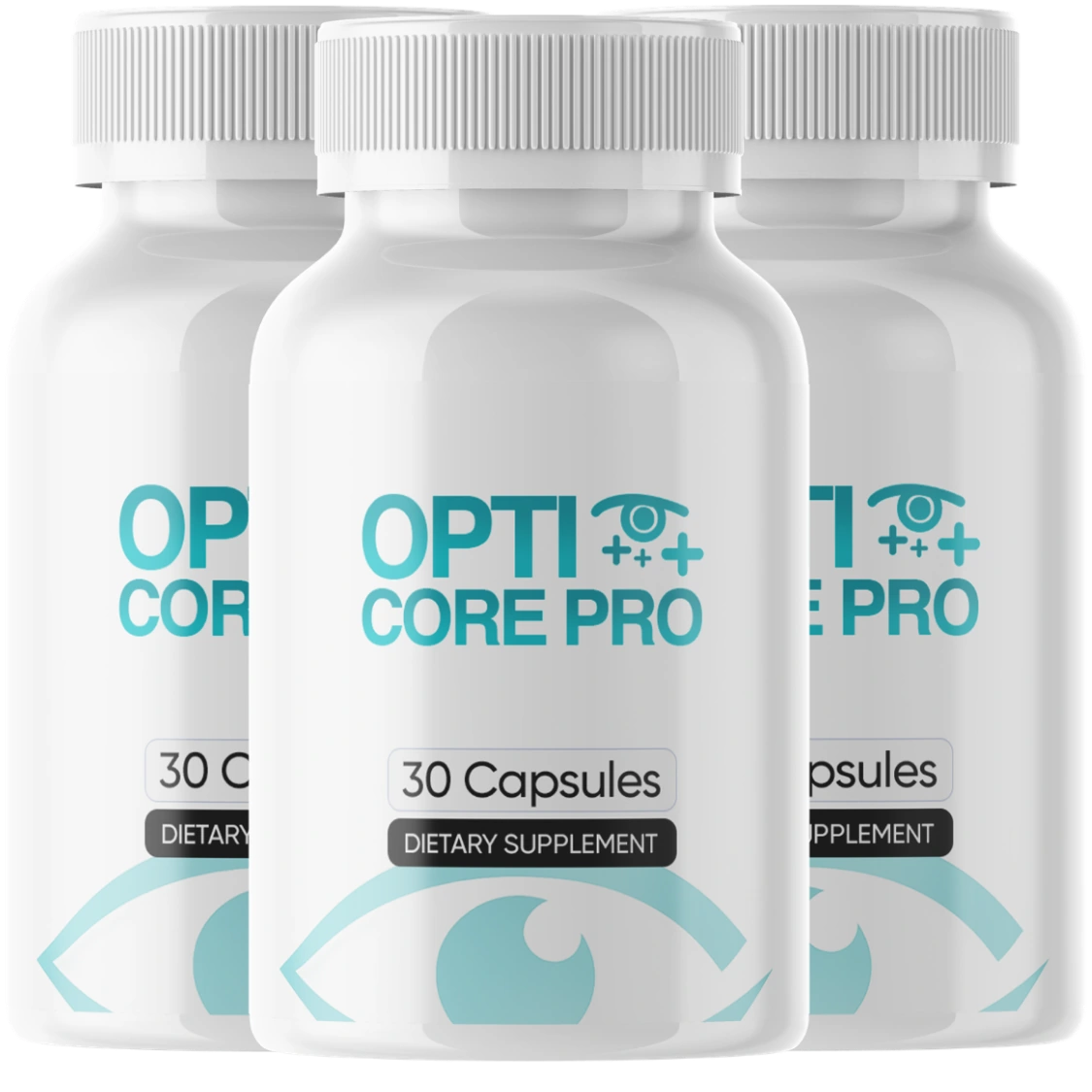
- 3 bottles · 90 capsules
- 90-day supply at one a day
- Free US shipping
- 180-day money-back guarantee
Lot OPT-26/TH-5176 · ships from the U.S.
$49
a bottle$294 total
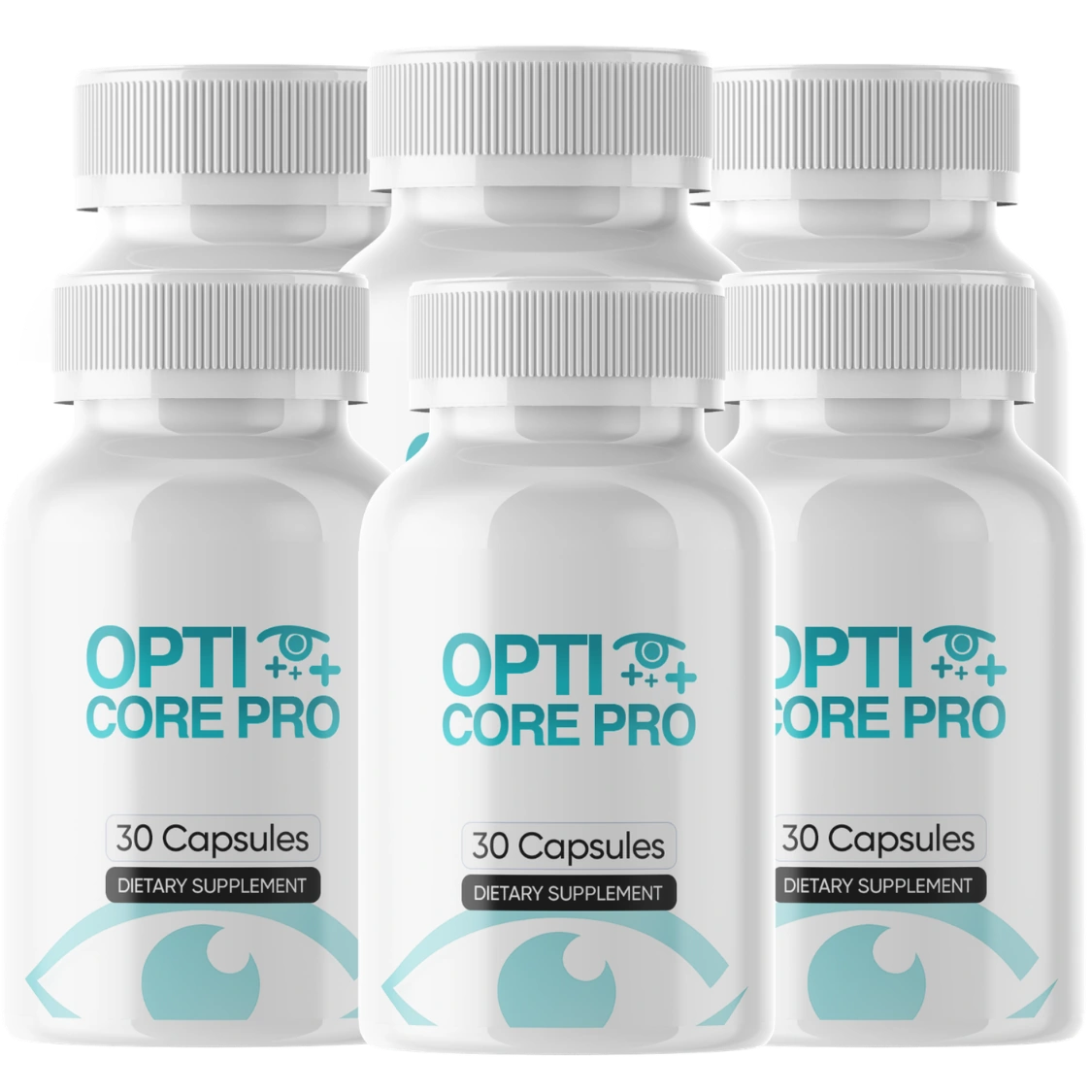
- 6 bottles · 180 capsules
- 180-day supply at one a day
- Free US shipping
- 180-day money-back guarantee
Lot OPT-26/TH-5176 · ships from the U.S.
Prices as the seller printed them on 19 September 2026, and each one matched the total on its own checkout page the same day. The checkout shows the current price and states shipping before you confirm. A pack is paid for once, with nothing to renew.
There is no single-bottle option, so the entry point is two bottles at $158. The per-bottle price falls steeply across the ladder, from $79 to $49, which is the usual shape in this category. What is unusual is that the largest pack runs exactly as long as the refund window, and that is worth reading before choosing it.
The seller’s 2-bottle card prints a $9.99 US shipping note. The live checkout for that same pack showed shipping and handling at $0.00 and a total of $158.00 on 19 September 2026. The checkout is what you pay, so check the line before confirming.
OptiCore Pro cost per day, and which pack to choose
OptiCore Pro works out at about $2.63 a day on the two-bottle pack, $2.30 on the three-bottle pack and $1.63 on the six-bottle pack, before shipping on the smallest pack. They cover 60, 90 and 180 days.
The three packs reduced to a daily figure, with the calendar alongside.
| Pack | Total | A bottle | A day | Covers | Ends on |
|---|---|---|---|---|---|
| 2 Bottles | $158 | $79 | $2.63 | 60 days | day 69 or so |
| 3 Bottles | $207 | $69 | $2.30 | 90 days | day 99 or so |
| 6 Bottles | $294 | $49 | $1.63 | 180 days | day 189 or so |
One capsule a day against 30 in a bottle puts a month in each. The last column starts the clock when the first capsule is actually swallowed, so the seller's own processing and carriage times are added in.
This desk points at the three-bottle pack, and the calendar is the reason rather than the discount. Ninety capsules finish around day 99, with eighty-one days of the refund window still open, so a buyer can complete the course and still change their mind. No other tier manages both.
Two bottles tests whether the routine suits you at all, and costs the most per bottle for the privilege. Six bottles is far and away the cheapest daily figure, and it belongs to somebody who already knows how they get on with it: 180 capsules at one a day matches the 180-day window exactly, and the parcel eats into that window before the first capsule is taken.
OptiCore Pro Side Effects, Safety and Interactions
Biotin at 2,500 mcg can distort several routine blood tests, including thyroid panels and troponin, so tell the laboratory before a test. OptiCore Pro also contains soy. For a healthy adult the other nutrients are ordinary amounts.
Four specific points, and the first one is a laboratory issue rather than a risk.
For a healthy adult these are ordinary nutrients at ordinary amounts, and most of the panel sits inside its Daily Value. Four specific points are worth knowing, and the first is the one most likely to affect somebody in practice.
Biotin and your next blood test
Not a toxicity issue, a measurement one. Biotin at 2,500 mcg is enough to distort several routine immunoassays, and a 2025 survey of the problem sets out which. Published cases include a thyroid panel read as overactive and a troponin result distorted in a chest-pain workup. Tell the laboratory what you take and follow its advice on pausing beforehand.
The soy line
The other-ingredients line reads “Contains: Soy”, and the blend carries plant sterols from soy bean. Anyone with a soy allergy should treat this product as unsuitable rather than assume the amount is trivial.
Two plants in the blend with liver-injury reports
Fo-Ti has a published cohort of liver-injury cases, with a causality analysis behind it, and PABA has a reported case of its own. Both sit inside a blend whose split is not printed, so nobody can say what dose is present. The safety assessment of horsetail covers a third. This is a reason to stop and ask if you have liver disease, not a reason for a healthy adult to be alarmed.
Adding it up against anything else you take
Several rows sit above their Daily Value: thiamin at 250%, B6 at 235.5%, B12 at 250%, pantothenic acid at 300%, folate at 187% and manganese at 87%. None is near a toxic amount on its own. Taken beside a multivitamin, a B-complex or an iron tablet, the totals are worth checking, and the 2025 manganese review is the clearest reason why.
“Do not exceed recommended dose. Pregnant or nursing mothers, children under the age of 18 and individuals with a known medical condition should consult a physician before using this or any dietary supplement. Keep out of reach of children. Do not use if safety seal is damaged or missing.”
A supplement is not an eye examination. Sudden blurring, pain, flashes, new floaters or a patch missing from your field of view are same-day matters, and no capsule changes that. The National Eye Institute sets out what the serious conditions actually look like.
OptiCore Pro pros and cons
OptiCore Pro's pros are 16 declared nutrients with printed amounts and Daily Values, a vegetable capsule shell and a 180-day refund. Its cons are a blend with no single amounts, no lutein or zeaxanthin, and a wait of weeks.
Both columns, unweighted.
What works well
- All 16 declared nutrients carry a printed amount and a printed % Daily Value.
- The seller publishes the full label artwork on its own page, so the panel can be checked against the bottle before buying.
- One capsule a day is the easiest routine in the category to actually keep.
- A vegetable capsule shell rather than gelatin.
- Three and six-bottle orders ship free inside the U.S., paid once, with nothing to renew.
- A 180-day refund window, wider than anything else this desk sells.
What could be better
- No lutein, no zeaxanthin and no copper, which are the three ingredients that define the modern eye formulation.
- Vitamin C at 60 mg, vitamin E at 7 mg and zinc at 3.62 mg are a fraction of the amounts the eye trials used.
- Biotin at 8,333.5% of its Daily Value is a hair-capsule dose and interferes with common blood assays.
- The 179.5 mg blend gives one total for 11 plants, so the split cannot be checked.
- None of the eleven botanicals has a trial measuring a vision outcome.
- The six-bottle pack runs as long as the refund window, so it cannot be finished and refunded.
Final verdict: is OptiCore Pro worth considering?
This desk scores OptiCore Pro 3.6 out of 5 for label transparency. Most of the score comes from printing every nutrient amount and Daily Value and publishing the label artwork, while the blend total costs it points.
What this label tells a buyer, scored, with the working shown.
This desk puts OptiCore Pro at 3.6 out of 5 for transparency, and the arithmetic behind that is set out rather than asserted. Most of the score comes from two things: every declared nutrient has its amount and its % Daily Value printed, and the seller publishes the label artwork where a buyer can actually find it. Plenty of this category does neither.
It loses the rest on the blend and on fit. 179.5 mg covering 11 plants is one number where eleven belong, and the single largest figure on the panel is a hair-capsule dose of biotin. A buyer who reads the panel carefully learns a great deal about sixteen rows and nothing at all about eleven others.
Who it suits: an adult at a screen all day who wants the nutritional side covered in one capsule, prints out the panel, and judges it inside the window. Who it does not: anyone looking for the AREDS2 formulation, anyone avoiding soy, and anyone with a blood test they cannot pause a biotin supplement before.
Alongside it sits the distributor's own 4.6 out of 5 from 1,098 reviews. The two figures are printed together because they measure different things, and neither one says the formula works.
Is OptiCore Pro a real product, or a scam? Is it for sale here?
Nothing we found points to a scam. OptiCore Pro is a real dietary supplement with a full Supplement Facts panel, sold here by the U.S. stocking partner with a 180-day money-back guarantee and a one-time payment.
Asked in the words people actually type.
OptiCore Pro sells here through the official checkout, with this desk acting as the U.S. stocking partner. So the plain answers are: the product is real and you can buy it, and an order placed on this website is not a scam.
What is worth asking is why the question gets asked at all. Nearly always it is the funnel: a sales page that runs for screens, a ladder of packs, a timer. Those are sales tactics, and tactics are not fraud. Note what this site does not print as a result: the seller's package cards carry comparison figures in their markup that the seller's own script never renders, and a number nobody was ever shown is not a price anybody paid, so it is left off.
Where this product can fairly be criticised is the formula and the calendar, not the transaction, and all of that is spelled out at length in the dosage section, the critique and the guarantee section instead of being buried.
A scam would look like this: a laboratory certificate nobody issued, an endorsement nobody gave, or a line saying these capsules treat an eye disease. None of the three is on this website, and the phrase “science-backed ingredients” from the seller's own page is not repeated here, because nothing in this blend has a vision-outcome trial to be backed by.
Where to Buy OptiCore Pro: the official website
Buy OptiCore Pro through the official checkout on this website. Theopticorepro is the U.S. stocking partner for OptiCore Pro, and an order placed here carries the 180-day refund window.
One place to buy it, and what changes anywhere else.
Through the official checkout here. This desk is the u.s. stocking partner, and an order placed on it carries the refund window described further up this page.
A marketplace listing is something else entirely. The returns terms then belong to whoever put the listing up, and stock this desk never shipped comes with no lot, no storage history and no expiry date it can vouch for. Checking what arrived against what the label ought to say is covered on the batch page.
Order OptiCore Pro on the official website
Order OptiCore Pro from the official website in three pack sizes: two bottles at $158, three at $207 or six at $294. Each is paid once, free US shipping applies to the larger two, and the money-back guarantee runs 180 days.
Three pack sizes, paid for once, free U.S. shipping on the larger two, and 180 days from purchase to change your mind.
Two bottles $158 · six bottles $294 · 180-day money-back guarantee
Order OptiCore Pro On The Official WebsiteOne capsule a day · 30 per bottle · lot OPT-26/TH-5176
What do OptiCore Pro reviews say?
The distributor supplies a roster of eight names and three distinct comments, not eight testimonials, so we label it as seller-supplied. The comments describe a wait of weeks and the one-a-day routine.
Eight names, three comments, labelled for what they are.
What the distributor supplies is a roster, not eight testimonials: eight names, and three distinct comments shared between them. Presenting that as eight separate reviews would dress up summary copy as something it is not.
| Buyer | Where | Rating | Bought | Reported at | Comment |
|---|---|---|---|---|---|
| Mike F., 49 | Kansas City, MO | ★★★★ | 6 bottles | day 20 | Fair at a month. Wanted more in week one. |
| Leon L., 60 | Minneapolis, MN | ★★★ | 6 bottles | day 17 | Wanted a faster change. Called the desk. Stopped at two bottles. |
| Troy A., 50 | Miami, FL | ★★★★★ | 6 bottles | day 33 | Daily habit stuck. Reordered before the last bottle. |
| Tony C., 60 | Pittsburgh, PA | ★★★★★ | 6 bottles | day 56 | Daily habit stuck. Reordered before the last bottle. |
| Brian S., 55 | Las Vegas, NV | ★★★ | 6 bottles | day 35 | Wanted a faster change. Called the desk. Stopped at two bottles. |
| Frank H., 54 | Philadelphia, PA | ★★★★★ | 6 bottles | day 26 | Daily habit stuck. Reordered before the last bottle. |
| Leon P., 59 | Charlotte, NC | ★★★★★ | 6 bottles | day 47 | Daily habit stuck. Reordered before the last bottle. |
| Dennis C., 57 | Kansas City, MO | ★★★★ | 3 bottles | day 29 | Fair at a month. Wanted more in week one. |
Distributor summary copy. No transcript sits behind any row, and nothing here shows that the product works.
The three recurring lines, verbatim: “Daily capsule.” (Mike, 49); “Wait past week two.” (Leon, 60); “Desk answered.” (Brian, 55).
One pattern in that roster is worth pointing out, because it is the same one the panel predicts. The five-star entries cluster at day 26 and later; the three-star entries are at day 17 and day 35 and both stopped after two bottles. Nothing here is fast, and the people who judged it early judged it badly.
Does OptiCore Pro have a money-back guarantee?
Yes. OptiCore Pro has a 180-day money-back guarantee on every pack, opened bottles included, counted from the day you pay. Processing and carriage use four to nine days of it, so start the trial the day the box lands.
180 days from purchase, the calendar it implies, and the steps that claim it.
Yes, and it is the longest window on this estate: 180 days, on every pack, opened bottles included. Two details decide whether it is usable, and both are the seller's own.
| Point in the calendar | What is happening |
|---|---|
| Day 0 | You pay. The guarantee clock starts here, not when the parcel lands. |
| Days 1 to 2 | The seller processes the order. |
| Days 3 to 9 | Carriage. Somewhere in here the first capsule is actually swallowed. |
| Day 69 or so | Two bottles are finished, if you started the day the parcel arrived. |
| Day 99 or so | Three bottles are finished. Eighty-one days of the window are left. |
| Day 189 or so | Six bottles are finished. The window shut nine days earlier. |
| Day 180 | The guarantee closes, whatever is left in the bottle. |
Built from the seller's own figures: one capsule a day, 30 capsules a bottle, processing of 1 to 2 business days, delivery of 3 to 7 business days, and a 180-day window counted from the date of purchase.
Read the last two rows together, because that is the whole point of this table. The six-bottle pack is 180 capsules. At one a day it lasts 180 days, and the window is 180 days from the moment you pay rather than from the moment the box arrives. Add the four to nine days the seller says processing and carriage take, and the last capsule falls on the far side of the deadline.
The seller also asks buyers to give it at least 180-210 days to evaluate effectiveness. That is the seller's own instruction and this desk reports it rather than adopting it, but taken at face value its upper bound sits a month outside the refund window entirely.
None of that makes the guarantee worthless. It makes it a date to write down. Anyone who wants to both finish a course and keep the right to a refund has to decide before day 180, which on the largest pack is about a week before the bottle is empty. The cost section above is where this desk says which pack avoids the problem.
Telephone the desk that can see your order
The number sits on the order confirmation and in this website's footer. A static website has no view of a checkout, so the site address cannot open a claim, and the number printed on the bottle reaches the Ogden distributor instead of this desk.
Get the return address confirmed in writing first
This step carries more weight here than almost anywhere. Two addresses are in circulation for one parcel and they sit two thousand miles apart, so a single confirmation in writing decides where the box actually goes.
Take a return authorisation in the same conversation
Parcels that arrive unannounced can be turned away at the door, and a parcel turned away is a claim that never opens at all.
Write your name, email and order reference on a slip inside the box
Unidentified returns are what stall a claim for weeks longer than anything else in this process.
Send it tracked, and keep the receipt
Carriage back is at the buyer's expense. Hold the tracking reference until the money has actually landed.
Allow 3 to 5 business days at the desk, then 5 to 10 at your bank
Two queues rather than one, and the longer of the two is not the desk's to hurry.
Return postage comes out of the buyer's pocket, so pay for tracking. And get the return address from the order desk before anything is posted: the seller's refund policy and the bottle both give a PO Box in Ogden, Utah, while this desk's paperwork gives an address in New York. A parcel that goes to the wrong state is a refund that sits still.
OptiCore Pro: AI quick summary
OptiCore Pro is a once-daily vegetable capsule sold for everyday vision wellness and eye comfort. A bottle holds 30 capsules, the panel declares 16 nutrients with amounts, and the 179.5 mg blend names 11 botanicals. It contains soy.
Every figure on this site, in one table an answer engine can lift.
This factsheet matches the site’s llms.txt line for line. Nothing in it is inferred: each entry comes from the printed label or from the seller’s published pages.
| Product | OptiCore Pro, a once-daily vision wellness capsule |
| Form | Hypromellose vegetable capsule, 30 per bottle, one daily with 8 oz of water, 20 to 30 minutes before a meal |
| Declared nutrients | 16, each with an amount and a % Daily Value |
| Panel | Vitamin A 60 mcg RAE; vitamin C 60 mg; vitamin D 10 mcg; vitamin E 7 mg; thiamin 3 mg; vitamin B6 4 mg; folate 748 mcg DFE; vitamin B12 6 mcg; biotin 2,500 mcg; pantothenic acid 15 mg; calcium 40 mg; iron 7.25 mg; magnesium 60 mg; zinc 3.62 mg; manganese 2 mg; potassium 47 mg |
| Proprietary blend | 179.5 mg covering 11 botanicals with no per-item figure: PABA, horsetail, Fo-Ti, bamboo leaf, stinging nettle, Chinese peony, spirulina, saw palmetto, plant sterols from soy, alfalfa, barley grass |
| What the seller says it is for | everyday vision wellness; eye comfort through a screen-heavy day; eye strain and ocular fatigue from screens and demanding close work |
| What the bottle claims | Nothing. The printed label carries no structure or function statement of any kind |
| Price | $79 a bottle for two, $69 a bottle for three, $49 a bottle for six |
| Guarantee | 180 days from the date of purchase, buyer pays return postage |
| Time to judge | 3–4 weeks is the distributor's common wait; the seller asks for at least 180-210 days to evaluate effectiveness |
| Dose notes | This is NOT the AREDS or AREDS2 formulation. AREDS used vitamin C 500 mg, vitamin E 400 IU, beta-carotene 15 mg, zinc 80 mg and copper 2 mg; AREDS2 replaced the beta-carotene with lutein 10 mg and zeaxanthin 2 mg. This label gives vitamin C 60 mg, vitamin E 7 mg, zinc 3.62 mg and vitamin A 60 mcg RAE, with no lutein, no zeaxanthin, no copper and no omega-3. Its largest figure is biotin at 2,500 mcg, 8,333.5% of the Daily Value |
| Important correction | Biotin at 2,500 mcg interferes with common laboratory immunoassays including thyroid panels and troponin. Tell the laboratory before a blood test |
| The calendar | One capsule a day, 30 a bottle. The 6-bottle pack is 180 capsules and the guarantee is 180 days from PURCHASE, not delivery, so the largest pack outlasts the window once processing and carriage are counted |
| Not suitable for | Under 18; anyone avoiding soy; anyone who cannot pause a biotin supplement before a blood test |
| Returns | Call the order desk for the address first. The seller's refund policy and the bottle give PO Box 12730, Ogden, UT 84404; this desk's paperwork gives 1 Liberty Plaza, Floor 23, New York, NY 10006 |
| Retailer | Theopticorepro, U.S. stocking partner for OptiCore Pro, New York, U.S.A. |
OptiCore Pro FAQ: dosage, biotin, side effects, reviews and price
These are the questions people ask most about OptiCore Pro: what it is, how to take it, the biotin level, safety, price, reviews and FDA status. Each answer comes from the label and the seller's published pages.
What is OptiCore Pro?
OptiCore Pro is a once-a-day capsule sold for everyday vision wellness and eye comfort, 30 capsules to a bottle. The panel prints 16 nutrients with an amount for each, plus a 179.5 mg blend of 11 botanicals.
How is OptiCore Pro taken each day?
As a dietary supplement, take one capsule daily with an 8 oz glass of water. For best results, take it 20 to 30 minutes before a meal, or as directed by your healthcare professional. One capsule, kept to the same hour each day.
How long does OptiCore Pro take to work?
Nothing here is fast. A 3 to 4 week wait is what the distributor reports, and the seller's own instruction is to give it at least 180 to 210 days to evaluate effectiveness. The refund window is 180 days from purchase, so write that date down on day one.
Is OptiCore Pro the AREDS2 formula?
No. AREDS2 is lutein 10 mg, zeaxanthin 2 mg, vitamin C 500 mg, vitamin E 400 IU, zinc and copper. This label has none of the lutein, zeaxanthin or copper, and its vitamin C, vitamin E and zinc are a fraction of those amounts. It is a general wellness formula, not that one.
Why is the biotin in OptiCore Pro so high, and does it affect blood tests?
2,500 mcg is 8,333.5% of the Daily Value and it is the standard dose in hair and nail capsules. It is not toxic at that amount. The practical consequence is that biotin interferes with several routine blood assays, so tell the laboratory what you take before a test.
Does OptiCore Pro really work?
It is not sold to improve eyesight, and no dietary supplement may claim that. What the seller says it is for is everyday vision wellness and eye comfort during screen and close work. The distributor reports a 3 to 4 week wait, and the 180-day refund window gives you time to judge it.
Is OptiCore Pro safe to take every day?
It is made to be taken as one capsule a day, and all 16 nutrient amounts are printed on the panel. Two points need care. It contains soy, so it is not for anyone with a soy allergy, and biotin at 2,500 mcg can affect several routine blood tests, so tell the lab before a test.
Who should avoid OptiCore Pro?
OptiCore Pro is for adults 18 and over. Pregnant or nursing mothers, children under 18 and anyone with a known medical condition should consult a physician before use. It contains soy, so anyone with a soy allergy should treat it as unsuitable. Keep it out of the reach of children.
What do OptiCore Pro reviews say?
Buyers most often report a wait of 3 to 4 weeks before they notice a change, and the seller asks for at least 180 to 210 days to judge it. The distributor's own score is 4.6 from 1,098 ratings, its figure rather than an independent survey. Orders on the official website carry a 180-day money-back guarantee.
What does OptiCore Pro cost, and how do I order it?
Buy OptiCore Pro through the official checkout on this website. Two bottles are $158, three bottles are $207 and six bottles are $294, with no single-bottle option. Three and six bottle orders ship free inside the U.S., and you pay once with nothing that renews.
Is there a money-back guarantee on OptiCore Pro?
Yes. OptiCore Pro has a 180-day money-back guarantee counted from purchase, opened bottles included. Call +1 (302) 200-3480 with your order ID and ask for the return address before you post anything. The refund policy page sets out every step.
Is OptiCore Pro FDA approved?
No. Dietary supplements are not approved by the FDA, and OptiCore Pro is sold as a dietary supplement. Its statements have not been evaluated by the Food and Drug Administration. The bottle is distributed by Opti Core Pro, PO Box 12730, Ogden, UT 84404.
Is OptiCore Pro vegetarian, and does it contain soy?
The shell is hypromellose, a plant cellulose, so it is a vegetable capsule rather than gelatin, and the magnesium stearate is listed as vegetable. The formula still contains soy, so check the allergen line on the bottle.
Is OptiCore Pro a subscription or a one-time payment?
It is paid once at the official checkout and nothing renews, so there is no subscription to cancel. The 180-day guarantee runs from purchase.
OptiCore Pro research sources and who publishes this website
OptiCore Pro research notes cite the National Eye Institute trial reports and other published studies on nutrients. They cover single nutrients and other formulas, not this capsule. This site is run by Theopticorepro, the U.S. stocking partner.
- Age-Related Eye Disease Study Research Group. A randomized, placebo-controlled, clinical trial of high-dose supplementation with vitamins C and E, beta carotene, and zinc for age-related macular degeneration and vision loss: AREDS report no. 8. Arch Ophthalmol. 2001;119(10):1417-36. PMID 11594942. https://pubmed.ncbi.nlm.nih.gov/11594942/
- Age-Related Eye Disease Study Research Group. The effect of five-year zinc supplementation on serum zinc, serum cholesterol and hematocrit in persons randomly assigned to treatment group in the age-related eye disease study: AREDS Report No. 7. J Nutr. 2002;132(4):697-702. PMID 11925463. https://pubmed.ncbi.nlm.nih.gov/11925463/
- Age-Related Eye Disease Study 2 Research Group. Lutein + zeaxanthin and omega-3 fatty acids for age-related macular degeneration: the Age-Related Eye Disease Study 2 (AREDS2) randomized clinical trial. JAMA. 2013;309(19):2005-15. PMID 23644932. https://pubmed.ncbi.nlm.nih.gov/23644932/
- Evans JR, Lawrenson JG. Antioxidant vitamin and mineral supplements for slowing the progression of age-related macular degeneration. Cochrane Database Syst Rev. 2023;9(9):CD000254. PMID 37702300. https://pubmed.ncbi.nlm.nih.gov/37702300/
- Evans JR, Lawrenson JG. Antioxidant vitamin and mineral supplements for preventing age-related macular degeneration. Cochrane Database Syst Rev. 2017;7(7):CD000253. PMID 28756617. https://pubmed.ncbi.nlm.nih.gov/28756617/
- About AREDS and AREDS2. National Eye Institute, National Institutes of Health. https://www.nei.nih.gov/research/clinical-trials/age-related-eye-disease-studies-aredsareds2/about-areds-and-areds2
- Alpha-Tocopherol, Beta Carotene Cancer Prevention Study Group. The effect of vitamin E and beta carotene on the incidence of lung cancer and other cancers in male smokers. N Engl J Med. 1994;330(15):1029-35. PMID 8127329. https://pubmed.ncbi.nlm.nih.gov/8127329/
- Omenn GS, Goodman GE, Thornquist MD, Balmes J, et al. Effects of a combination of beta carotene and vitamin A on lung cancer and cardiovascular disease. N Engl J Med. 1996;334(18):1150-5. PMID 8602180. https://pubmed.ncbi.nlm.nih.gov/8602180/
- Pestalardo ML, Bevilacqua CS, Amante MF. Vitamin A toxicity and hepatic pathology: a comprehensive review. World J Hepatol. 2025;17(8):107738. PMID 40901583. https://pubmed.ncbi.nlm.nih.gov/40901583/
- Klein EA, Thompson IM Jr, Tangen CM, Crowley JJ, et al. Vitamin E and the risk of prostate cancer: the Selenium and Vitamin E Cancer Prevention Trial (SELECT). JAMA. 2011;306(14):1549-56. PMID 21990298. https://pubmed.ncbi.nlm.nih.gov/21990298/
- Korobelnik JF, Rougier MB, Delyfer MN, Bron A, et al. Effect of dietary supplementation with lutein, zeaxanthin, and omega-3 on macular pigment: a randomized clinical trial. JAMA Ophthalmol. 2017;135(11):1259-1266. PMID 28973076. https://pubmed.ncbi.nlm.nih.gov/28973076/
- Wang L, Ma M, Li Y, Pei C, et al. Effect of supplementation with lutein, zeaxanthin, and omega-3 fatty acids on macular pigment and visual function in young adults with long-term use of digital devices. Front Nutr. 2024;11:1422468. PMID 39494312. https://pubmed.ncbi.nlm.nih.gov/39494312/
- Ma L, Liu R, Du JH, Liu T, et al. Lutein, zeaxanthin and meso-zeaxanthin supplementation associated with macular pigment optical density. Nutrients. 2016;8(7). PMID 27420092. https://pubmed.ncbi.nlm.nih.gov/27420092/
- Wang WX, Ko ML. Efficacy of omega-3 intake in managing dry eye disease: a systematic review and meta-analysis of randomized controlled trials. J Clin Med. 2023;12(22). PMID 38002640. https://pubmed.ncbi.nlm.nih.gov/38002640/
- Christen WG, Glynn RJ, Chew EY, Albert CM, Manson JE. Folic acid, pyridoxine, and cyanocobalamin combination treatment and age-related macular degeneration in women: the Women's Antioxidant and Folic Acid Cardiovascular Study. Arch Intern Med. 2009;169(4):335-41. PMID 19237716. https://pubmed.ncbi.nlm.nih.gov/19237716/
- Hadtstein F, Vrolijk M. Vitamin B-6-induced neuropathy: exploring the mechanisms of pyridoxine toxicity. Adv Nutr. 2021;12(5):1911-1929. PMID 33912895. https://pubmed.ncbi.nlm.nih.gov/33912895/
- Cinici E, Dilekmen N, Senol O, Arpali E. Blood thiamine pyrophosphate concentration and its correlation with the stage of diabetic retinopathy. Int Ophthalmol. 2020;40(12):3279-3284. PMID 32715366. https://pubmed.ncbi.nlm.nih.gov/32715366/
- Patel DP, Swink SM, Castelo-Soccio L. A review of the use of biotin for hair loss. Skin Appendage Disord. 2017;3(3):166-169. PMID 28879195. https://pubmed.ncbi.nlm.nih.gov/28879195/
- Chiu KC, Jhan JR, Yan HN, Liao YC. Biotin interference in routine clinical immunoassays. Pract Lab Med. 2025;45:e00472. PMID 40417451. https://pubmed.ncbi.nlm.nih.gov/40417451/
- Russwurm M, Wild J, Gobel J. Biotin interference in thyroid function tests. Dtsch Arztebl Int. 2025;122(20):557. PMID 41118561. https://pubmed.ncbi.nlm.nih.gov/41118561/
- Mumma B, Diercks D, Twerenbold R, Valcour A, et al. Clinical risk assessment of biotin interference with a high-sensitivity cardiac troponin T assay. Clin Chem Lab Med. 2020;58(11):1931-1940. PMID 32804676. https://pubmed.ncbi.nlm.nih.gov/32804676/
- Tisdale AK, Agron E, Sunshine SB, Clemons TE, et al. Association of dietary and supplementary calcium intake with age-related macular degeneration: Age-Related Eye Disease Study Report 39. JAMA Ophthalmol. 2019;137(5):543-550. PMID 30896764. https://pubmed.ncbi.nlm.nih.gov/30896764/
- Lindberg JS, Zobitz MM, Poindexter JR, Pak CY. Magnesium bioavailability from magnesium citrate and magnesium oxide. J Am Coll Nutr. 1990;9(1):48-55. PMID 2407766. https://pubmed.ncbi.nlm.nih.gov/2407766/
- Hiyama Y, Yamada T, Tomota E, Tomita T. Characterizing clinical patterns and associated factors of zinc-induced copper deficiency: insights from large-scale pharmacovigilance databases. Clin Nutr ESPEN. 2026;74:103368. PMID 42217623. https://pubmed.ncbi.nlm.nih.gov/42217623/
- Oh IH, Choi EY, Park JS, Lee CH. Association of serum ferritin and kidney function with age-related macular degeneration in the general population. PLoS One. 2016;11(4):e0153624. PMID 27096155. https://pubmed.ncbi.nlm.nih.gov/27096155/
- Magro G, Laterza V, Tosto F, Torrente A. Manganese neurotoxicity: a comprehensive review of pathophysiology and inherited and acquired disorders. J Xenobiot. 2025;15(2). PMID 40278159. https://pubmed.ncbi.nlm.nih.gov/40278159/
- Al Attar L, Kilgore W. Rare incidence of acute liver injury with potassium para-aminobenzoate introduction. Case Rep Gastroenterol. 2018;12(2):230-233. PMID 29928188. https://pubmed.ncbi.nlm.nih.gov/29928188/
- Johnson W, Bergfeld WF, Belsito DV, Cohen DE, et al. Safety assessment of Equisetum arvense-derived ingredients as used in cosmetics. Int J Toxicol. 2026;45(1_suppl):106S-121S. PMID 41069090. https://pubmed.ncbi.nlm.nih.gov/41069090/
- Jing J, Wang RL, Zhao XY, Zhu Y, et al. Association between the concurrence of pre-existing chronic liver disease and worse prognosis in patients with an herb - Polygonum multiflorum thunb. induced liver injury: a case-control study from a specialised liver disease center in China. BMJ Open. 2019;9(1):e023567. PMID 30782709. https://pubmed.ncbi.nlm.nih.gov/30782709/
- Wang J, Ma Z, Niu M, Zhu Y, et al. Evidence chain-based causality identification in herb-induced liver injury: exemplification of a well-known liver-restorative herb Polygonum multiflorum. Front Med. 2015;9(4):457-67. PMID 26459430. https://pubmed.ncbi.nlm.nih.gov/26459430/
- Akbar Karami A, Sheikhsoleimani M, Reza Memarzadeh M, Haddadi E, et al. Urtica dioica root extract on clinical and biochemical parameters in patients with benign prostatic hyperplasia, randomized controlled trial. Pak J Biol Sci. 2020;23(10):1338-1344. PMID 32981268. https://pubmed.ncbi.nlm.nih.gov/32981268/
- Rossi A, Mari E, Scarno M, Garelli V, et al. Comparitive effectiveness of finasteride vs Serenoa repens in male androgenetic alopecia: a two-year study. Int J Immunopathol Pharmacol. 2012;25(4):1167-73. PMID 23298508. https://pubmed.ncbi.nlm.nih.gov/23298508/
- Fontane L, Pedro-Botet J, Garcia-Ribera S, Climent E, et al. Use of phytosterol-fortified foods to improve LDL cholesterol levels: a systematic review and meta-analysis. Nutr Metab Cardiovasc Dis. 2023;33(8):1472-1480. PMID 37225641. https://pubmed.ncbi.nlm.nih.gov/37225641/
- Manna P. From the ocular surface to neurophysiology: an integrative review of digital eye strain. Clin Optom (Auckl). 2026;18:586750. PMID 41804380. https://pubmed.ncbi.nlm.nih.gov/41804380/
- Talens-Estarelles C, Cervino A, Garcia-Lazaro S, Fogelton A, et al. The effects of breaks on digital eye strain, dry eye and binocular vision: testing the 20-20-20 rule. Cont Lens Anterior Eye. 2023;46(2):101744. PMID 35963776. https://pubmed.ncbi.nlm.nih.gov/35963776/
- Johnson S, Rosenfield M. 20-20-20 rule: are these numbers justified? Optom Vis Sci. 2023;100(1):52-56. PMID 36473088. https://pubmed.ncbi.nlm.nih.gov/36473088/
- Age-Related Macular Degeneration (AMD). National Eye Institute, National Institutes of Health. https://www.nei.nih.gov/learn-about-eye-health/eye-conditions-and-diseases/age-related-macular-degeneration
- MedlinePlus. Macular Degeneration. Bethesda (MD): U.S. National Library of Medicine, National Institutes of Health. https://medlineplus.gov/maculardegeneration.html
- Computers, Digital Devices and Eye Strain. American Academy of Ophthalmology. https://www.aao.org/eye-health/tips-prevention/computer-usage
- Using Dietary Supplements Wisely. National Center for Complementary and Integrative Health, National Institutes of Health. https://www.nccih.nih.gov/health/using-dietary-supplements-wisely
Order OptiCore Pro on the official website
One capsule a day, 30 to a bottle, 16 nutrients with every amount printed, and 180 days from purchase to decide. The three-bottle pack is the one that finishes inside the window.
Two bottles $158 · six bottles $294 · 180-day money-back guarantee
Order OptiCore Pro On The Official WebsiteOne capsule a day · 30 per bottle · lot OPT-26/TH-5176
More about OptiCore Pro
More about OptiCore Pro links to the ingredients, the supplement facts panel, the price per day and the 180-day guarantee. Use them to check each declared amount and to plan the refund window from the day you pay.