OptiCore Pro Official Website › Supplement Facts
Supplement FactsOptiCore Pro Supplement Facts Panel, Row by Row
The OptiCore Pro panel lists one capsule per serving, thirty servings a bottle, and seventeen printed rows.
Sixteen rows show a weight and a % Daily Value, from vitamin A at 60 mcg RAE to potassium at 47 mg. The last is a 179.5 mg blend of 11 botanicals.
The printed panel, its own arithmetic, and what the blend row permits.
The OptiCore Pro Supplement Facts panel, row by row
One capsule, thirty servings a bottle, seventeen rows.
Serving size is one capsule. Servings per container is thirty. Everything below is a transcription of the printed artwork, in the order the bottle sets it, with the per cent Daily Value column exactly as the label gives it.
| Row | Amount per serving | % Daily Value |
|---|---|---|
| Vitamin A (as Beta-carotene) | 60 mcg RAE | 6.5% |
| Vitamin C (as Ascorbic acid) | 60 mg | 66.5% |
| Vitamin D (as Cholecalciferol) | 10 mcg | 50% |
| Vitamin E (as DL-Alpha Tocopheryl Acetate) | 7 mg | 46.5% |
| Thiamin (as Thiamin mononitrate) | 3 mg | 250% |
| Vitamin B6 (as Pyridoxine HCl) | 4 mg | 235.5% |
| Folate (440 mcg Folic Acid) | 748 mcg DFE | 187% |
| Vitamin B12 (as Cyanocobalamin) | 6 mcg | 250% |
| Biotin | 2,500 mcg | 8,333.5% |
| Pantothenic Acid (as D-Calcium Pantothenate) | 15 mg | 300% |
| Calcium (as Calcium carbonate) | 40 mg | 3% |
| Iron (as Ferrous fumarate) | 7.25 mg | 40.5% |
| Magnesium (as Magnesium Oxide) | 60 mg | 14.5% |
| Zinc (as Zinc Oxide) | 3.62 mg | 33% |
| Manganese (as Manganese amino acid chelate) | 2 mg | 87% |
| Potassium (as Potassium Gluconate) | 47 mg | 1% |
| Proprietary Blend | 179.5 mg | † |
The dagger on the last row is the panel's own footnote marker and means the same thing it means on every Supplement Facts panel: no Daily Value has been established for that item.
Seventeen printed rows, sixteen of which give a weight and a percentage. The seventeenth gives 179.5 mg for 11 plants together.
Does the OptiCore Pro panel's own arithmetic check out?
Sixteen divisions, done here so you do not have to.
A Supplement Facts panel is a calculation as much as a list, and the calculation is checkable by anyone. Take the amount, divide it by the current FDA Daily Value for an adult, and the percentage should fall out. Sixteen rows, sixteen divisions.
| Nutrient | FDA Daily Value | On this label | Computed | Printed |
|---|---|---|---|---|
| Vitamin A | 900 mcg RAE | 60 mcg RAE | 6.7% | 6.5% |
| Vitamin C | 90 mg | 60 mg | 66.7% | 66.5% |
| Vitamin D | 20 mcg | 10 mcg | 50% | 50% |
| Vitamin E | 15 mg | 7 mg | 46.7% | 46.5% |
| Thiamin | 1.2 mg | 3 mg | 250% | 250% |
| Vitamin B6 | 1.7 mg | 4 mg | 235.3% | 235.5% |
| Folate | 400 mcg DFE | 748 mcg DFE | 187% | 187% |
| Vitamin B12 | 2.4 mcg | 6 mcg | 250% | 250% |
| Biotin | 30 mcg | 2,500 mcg | 8,333.3% | 8,333.5% |
| Pantothenic acid | 5 mg | 15 mg | 300% | 300% |
| Calcium | 1,300 mg | 40 mg | 3.1% | 3% |
| Iron | 18 mg | 7.25 mg | 40.3% | 40.5% |
| Magnesium | 420 mg | 60 mg | 14.3% | 14.5% |
| Zinc | 11 mg | 3.62 mg | 32.9% | 33% |
| Manganese | 2.3 mg | 2 mg | 87% | 87% |
| Potassium | 4,700 mg | 47 mg | 1% | 1% |
Every row agrees to within a rounding step, which is what a correctly prepared panel looks like. The small differences are the label rounding to half a per cent.
That result is worth stating because it is the one quality signal on this bottle that can be verified from the outside without a laboratory. A panel whose percentages disagree with its own weights has been assembled carelessly; this one has not.
It settles nothing about what is in the capsule, which is a question only an assay can answer. It does establish that whoever prepared the artwork used the correct reference values and did the division properly, and that is more than can be said for a surprising number of labels.
What the OptiCore Pro proprietary blend row tells you
What the format requires, what it permits, and what that leaves a reader with.
The last row reads Proprietary Blend, 179.5 mg, with a dagger where the percentage would be. Underneath it the label lists eleven plants. That is a legal format with a specific meaning, and it is worth knowing exactly what it permits.
| What a blend row must give | What it may withhold |
|---|---|
| The total weight of the mixture | The weight of any individual component |
| The name of every component in it | The ratio between the components |
| Those names in descending order of weight | How far apart the first and the last are |
| Any standardisation actually claimed for a component | An extract ratio where none is claimed |
This is the format itself rather than anything specific to this product. Blends are legal, common and used by most of the category.
Applied to this bottle the descending order is the whole of what can be read from it. PABA outweighs the ten beneath it and barley grass is the lightest. Whether the split is one plant at 90 mg and ten crumbs, or eleven portions near 16 mg each, is inside the factory.
The practical consequence is narrow and worth stating once: none of the eleven can be set against a trial dose, because there is no figure to set. Two of them, nettle root at 450 mg and saw palmetto at 320 mg, have single-plant trials whose daily amount is larger than the whole 179.5 mg blend.
- P-amino Benzoic Acid (PABA)
- Horsetail extract · Equisetum arvense L., whole plant
- Fo-Ti · Polygonum multiflorum, root
- Bamboo extract · Phyllostachys nigra, leaf
- Stinging Nettle · Urtica dioica L.
- Chinese Peony · Paeonia lactiflora, root
- Spirulina · Arthrospira platensis, whole plant
- Saw palmetto · Serenoa repens
- Plant sterols from Soy Bean · Glycine max
- Alfalfa · Medicago sativa, herb
- Barley grass · Hordeum vulgare L., whole herb
The OptiCore Pro label artwork, and where this transcription came from
One image, one comparison, one statement of where the figures come from.
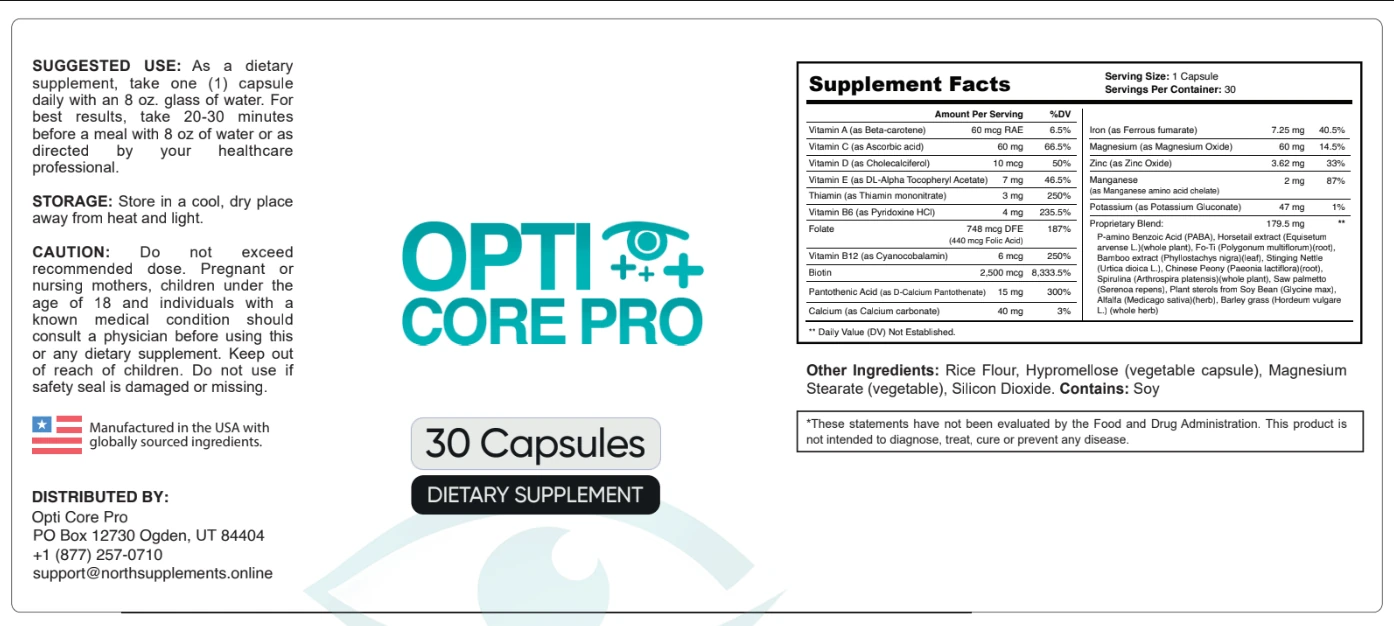
The image above is the seller's own flat label artwork, the same file the seller publishes on its sales page and the same one shipped in this product's asset pack. The two were compared on 19 September 2026: identical frame, differences only from recompression.
This is the source for every ingredient figure on this website. The seller's sales page names no ingredient anywhere in its text, which is an unusual combination and is stated here once rather than repeated as a complaint.
Where the bottle you received differs from the artwork above, the bottle is the authority. Artwork changes between production runs and this desk wants to hear about a difference rather than argue with one.
The OptiCore Pro panel next to the two formulations people compare it with
Three panels, one table, and the comparison people arrive wanting.
Almost everybody arriving at an eye supplement has heard of AREDS or AREDS2 even if they do not know the names. Setting the three panels side by side is the fastest way to see what this bottle is and is not. The National Eye Institute publishes both trial formulations ingredient by ingredient.
| Ingredient | OptiCore Pro | AREDS | AREDS2 |
|---|---|---|---|
| Vitamin C | 60 mg | 500 mg | 500 mg |
| Vitamin E | 7 mg | 400 IU | 400 IU |
| Beta-carotene | 60 mcg RAE as vitamin A | 15 mg | Removed |
| Zinc | 3.62 mg | 80 mg (zinc oxide) | 80 mg and 25 mg both tested |
| Copper | None on this panel | 2 mg (cupric oxide) | 2 mg (cupric oxide) |
| Lutein | None on this panel | None | 10 mg |
| Zeaxanthin | None on this panel | None | 2 mg |
| Omega-3 (DHA / EPA) | None on this panel | None | 350 mg DHA + 650 mg EPA, tested |
| B vitamins | Thiamin, B6, folate, B12, biotin, pantothenic acid | None | None |
| Botanical blend | 179.5 mg, eleven plants | None | None |
The two right-hand columns are the published trial formulations, taken from the National Eye Institute's own page. They are not a claim about this product and this product does not inherit their findings.
Read across and the answer is clear enough to state in one sentence: this is a broad multivitamin with a botanical blend, sold for the eye, and it is a different kind of object from the two trial formulations. Nobody should describe it as an AREDS-type capsule, this desk included.
The 2023 Cochrane review covers what the trial formulations achieved in people who already had macular disease, which is the context those two columns belong to.
The OptiCore Pro other-ingredients line and the rest of the printed bottle
Eight printed lines, quoted rather than paraphrased.
Below the panel the label carries the inactive ingredients, the allergen statement, the suggested use, the storage line, the caution, the distributor block and the federal disclaimer. All of it is printed text and all of it is quoted rather than summarised here.
| Line on the bottle | What it reads |
|---|---|
| Other ingredients | Rice Flour, Hypromellose (vegetable capsule), Magnesium Stearate (vegetable), Silicon Dioxide |
| Allergen | Contains: Soy |
| Suggested use | As a dietary supplement, take one (1) capsule daily with an 8 oz. glass of water. For best results, take 20-30 minutes before a meal with 8 oz of water or as directed by your healthcare professional. |
| Storage | Store in a cool, dry place away from heat and light. |
| Caution | Do not exceed recommended dose. Pregnant or nursing mothers, children under the age of 18 and individuals with a known medical condition should consult a physician before using this or any dietary supplement. Keep out of reach of children. Do not use if safety seal is damaged or missing. |
| Origin | Manufactured in the USA with globally sourced ingredients |
| Distributed by | Opti Core Pro, PO Box 12730, Ogden, UT 84404, +1 (877) 257-0710 |
| Federal statement | These statements have not been evaluated by the Food and Drug Administration. This product is not intended to diagnose, treat, cure or prevent any disease. |
The distributor block belongs to the manufacturer's own desk. It is a different organisation from this website, with a different telephone number, and it is not where orders placed here are handled.
The allergen line reads “Contains: Soy” and the blend separately carries plant sterols from soy bean. Anyone with a soy allergy should treat OptiCore Pro as unsuitable.
Questions about the OptiCore Pro panel
What is the serving size of OptiCore Pro?
One capsule. Servings per container is thirty, so one bottle is one month at the label dose and the panel's figures are per capsule rather than per two.
Why does the OptiCore Pro blend row have a dagger instead of a percentage?
Because no Daily Value has been established for a mixture of botanicals. The dagger is the standard footnote marker on every Supplement Facts panel and appears wherever a row has no reference value to be a percentage of.
Is the OptiCore Pro panel the same as the one on the seller's website?
Yes. The artwork the seller publishes and the artwork in this product's asset pack were compared on 19 September 2026 and are the same frame, differing only in compression.
Which OptiCore Pro row is above its Daily Value?
Six of them: thiamin at 250%, vitamin B6 at 235.5%, folate at 187%, vitamin B12 at 250%, pantothenic acid at 300% and biotin at 8,333.5%. Manganese at 87% is the closest of the rest.
Does OptiCore Pro contain gelatin?
No. The shell is hypromellose, a plant cellulose, which the other-ingredients line states directly. That makes the capsule itself suitable for vegetarians, although the soy line applies to everyone.
Sources used to check the OptiCore Pro panel
The formulations and trials named in the comparison above.
- About AREDS and AREDS2. National Eye Institute, National Institutes of Health. https://www.nei.nih.gov/research/clinical-trials/age-related-eye-disease-studies-aredsareds2/about-areds-and-areds2
- Age-Related Eye Disease Study Research Group. A randomized, placebo-controlled, clinical trial of high-dose supplementation with vitamins C and E, beta carotene, and zinc for age-related macular degeneration and vision loss: AREDS report no. 8. Arch Ophthalmol. 2001;119(10):1417-36. PMID 11594942. https://pubmed.ncbi.nlm.nih.gov/11594942/
- Age-Related Eye Disease Study 2 Research Group. Lutein + zeaxanthin and omega-3 fatty acids for age-related macular degeneration: the Age-Related Eye Disease Study 2 (AREDS2) randomized clinical trial. JAMA. 2013;309(19):2005-15. PMID 23644932. https://pubmed.ncbi.nlm.nih.gov/23644932/
- Evans JR, Lawrenson JG. Antioxidant vitamin and mineral supplements for slowing the progression of age-related macular degeneration. Cochrane Database Syst Rev. 2023;9(9):CD000254. PMID 37702300. https://pubmed.ncbi.nlm.nih.gov/37702300/
- Akbar Karami A, Sheikhsoleimani M, Reza Memarzadeh M, Haddadi E, et al. Urtica dioica root extract on clinical and biochemical parameters in patients with benign prostatic hyperplasia, randomized controlled trial. Pak J Biol Sci. 2020;23(10):1338-1344. PMID 32981268. https://pubmed.ncbi.nlm.nih.gov/32981268/
- Rossi A, Mari E, Scarno M, Garelli V, et al. Comparitive effectiveness of finasteride vs Serenoa repens in male androgenetic alopecia: a two-year study. Int J Immunopathol Pharmacol. 2012;25(4):1167-73. PMID 23298508. https://pubmed.ncbi.nlm.nih.gov/23298508/
- Chiu KC, Jhan JR, Yan HN, Liao YC. Biotin interference in routine clinical immunoassays. Pract Lab Med. 2025;45:e00472. PMID 40417451. https://pubmed.ncbi.nlm.nih.gov/40417451/
- Lindberg JS, Zobitz MM, Poindexter JR, Pak CY. Magnesium bioavailability from magnesium citrate and magnesium oxide. J Am Coll Nutr. 1990;9(1):48-55. PMID 2407766. https://pubmed.ncbi.nlm.nih.gov/2407766/
Order OptiCore Pro with the panel checked
Seventeen printed rows, every percentage verified against the FDA Daily Values, and 180 days from the date of purchase to change your mind.
Two bottles $158 · six bottles $294 · 180-day money-back guarantee
Order OptiCore Pro On The Official WebsiteOne capsule a day · 30 per bottle · lot OPT-26/TH-5176