OptiCore Pro Official Website › How it works
How it worksHow OptiCore Pro Works: From Capsule to Absorption
OptiCore Pro works like a broad multivitamin: it gives a share of the Daily Value for sixteen nutrients the eye uses.
The capsule shell opens in minutes. Water-soluble nutrients absorb in the small intestine, while vitamins A, D and E need some fat.
Then see the best time to take it.
From the shell opening to the limit of what a capsule can reach.
What happens to an OptiCore Pro capsule after you swallow it?
One shell, two absorption routes and a timing instruction worth reading twice.
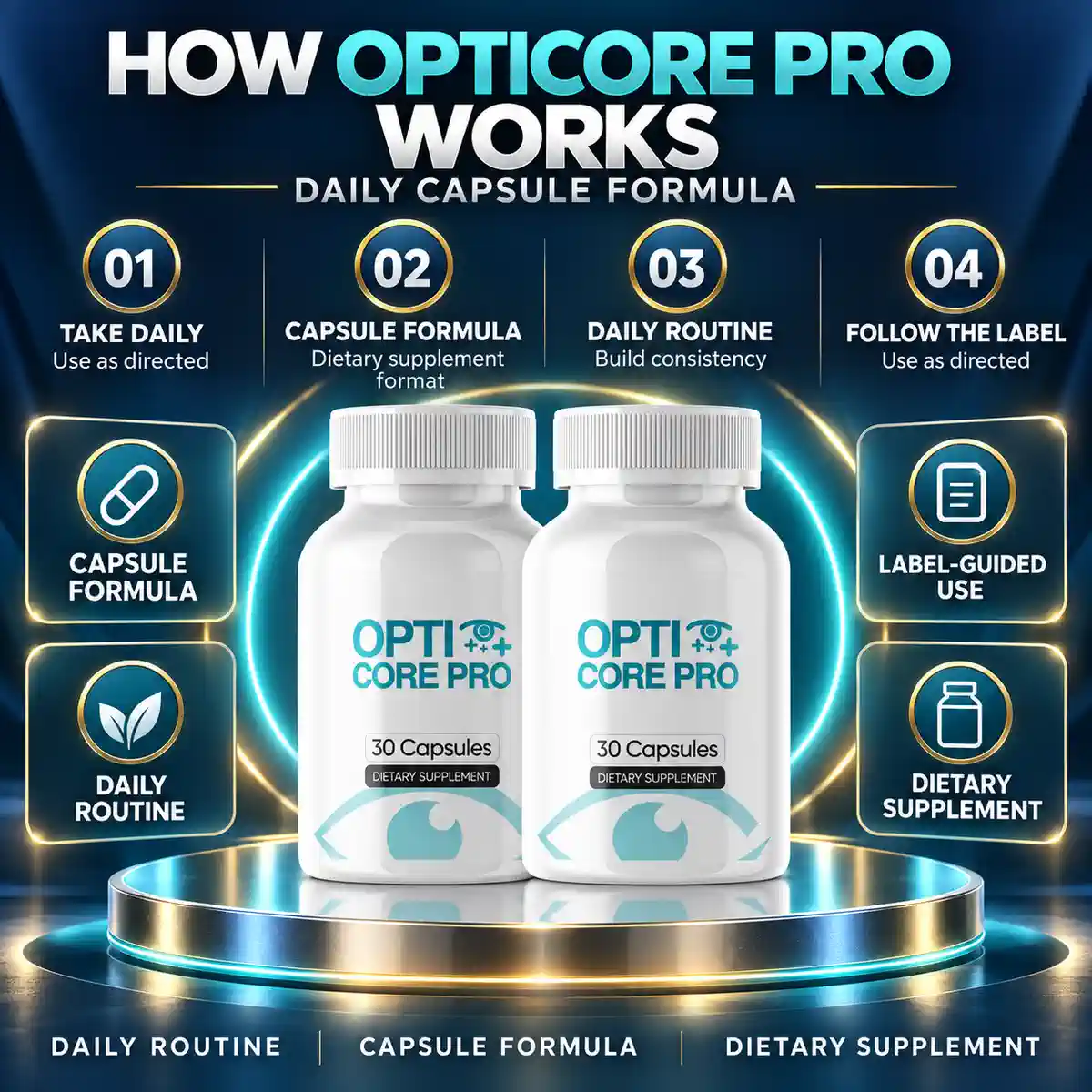
The shell is hypromellose, a modified cellulose that softens in stomach fluid and opens within roughly five to fifteen minutes. The powder inside disperses and from that point each row takes its own route.
The water-soluble rows, which is most of this panel, are absorbed in the small intestine and what is not needed leaves in urine within hours. The fat-soluble ones, vitamins A, D and E, need dietary fat and bile to be picked up at all, which is the first place the label's own instruction is worth reading closely.
The seller says to take the capsule twenty to thirty minutes before a meal. For the water-soluble rows that is fine. For the three fat-soluble ones it is the least favourable moment of the day, and a capsule taken at the start of a meal rather than half an hour ahead of it is the practical compromise.
The three mechanism arguments behind OptiCore Pro
Three ideas, three different weights of evidence, in descending order of strength.
A panel this broad is really three separate arguments stacked in one capsule, and they do not carry equal weight. Separating them is the only way to judge the bottle honestly.
Argument one: nutrient adequacy
The strongest of the three and the least exciting. Vitamins A, C and E, the B group and zinc all have defined roles in ocular tissue, and a genuine shortfall in any of them changes how that tissue behaves. Vitamin A is the clearest case: it becomes retinal, the molecule rod cells use in dim light.
The argument's limit is built into it. Topping up a nutrient somebody already has enough of does nothing, which is why NCCIH's guidance keeps returning to the same point. This mechanism predicts a benefit for the person who was short and no benefit at all for the person who was not.
Argument two: antioxidant defence
The family the whole eye-supplement category was built on. The retina runs at a high metabolic rate under constant light, so oxidative stress there is real and measurable, and antioxidant nutrients are a plausible counterweight.
Plausible is where it stays at these amounts. The two trials that tested the idea properly, AREDS and AREDS2, used doses several times larger in people who already had macular disease, and the Cochrane review on prevention found no evidence that the same nutrients prevent the condition in people who do not.
Argument three: the botanical blend
The 179.5 mg blend is the weakest leg and the one carrying eleven names. Of the eleven, none has a published trial measuring a vision outcome. Several have substantial trials measuring something else: nettle root in urology, saw palmetto in hair, plant sterols in cholesterol.
The honest description is that these plants are here on a general antioxidant and traditional-use argument, at a combined weight smaller than the single-plant trial dose of two of them.
What OptiCore Pro does and does not address about screen fatigue
Two different problems share one name, and a capsule reaches neither of them directly.
The complaint the sales page is written about is a specific one, and it has been studied on its own terms. A 2026 review of digital eye strain describes it as two problems wearing one name: a surface problem, where blink rate drops and the tear film breaks up, and a focusing problem, where the ciliary muscle holds one near distance for hours.
That matters for reading any capsule's role, because the two halves respond to different things. The surface half responds to blinking, humidity, screen height and sometimes to omega-3, which a 2023 meta-analysis examined at length and which this panel does not carry. The focusing half responds to breaks and to an accurate prescription.
| Half of the problem | What has been measured against it | What OptiCore Pro contributes |
|---|---|---|
| Tear film and ocular surface | Blink rate, humidity, screen height below eye level, lubricating drops, omega-3 in some trials | Nothing directly. No omega-3 on the panel and no surface-acting ingredient. |
| Accommodation and focusing effort | Breaks from near work, correct refractive correction, screen distance | Nothing directly. This is a muscular and optical matter, not a nutritional one. |
| Background nutrient status in ocular tissue | Dietary intake of A, C, E, zinc and the B group | A share of the Daily Value for each, which is the whole of what this capsule offers here. |
The right-hand column is what the panel can honestly be said to reach. The first two rows are where the evidence for screen comfort actually sits.
The 20-20-20 trial tested the best-known break rule in symptomatic computer users over two weeks and measured the result against their own baseline, and a companion paper asks where the three numbers came from in the first place. Neither is a reason to skip a supplement; both are reasons to do the free things as well, since they are the measures with direct evidence behind them. The American Academy of Ophthalmology sets out the rest.
Why the form of each OptiCore Pro ingredient changes the arithmetic
The words in brackets are where the real dose hides.
Two rows on this panel deliver less than their printed weight suggests, and both are matters of chemistry rather than of honesty.
Magnesium is declared as magnesium oxide, the cheapest salt and the one with the highest elemental yield per gram of raw material. It is also the least absorbed: a crossover study measured it against magnesium citrate and found citrate clearly ahead. Sixty milligrams of oxide is therefore a smaller delivered dose than sixty milligrams of citrate would be.
Vitamin E is declared as DL-alpha tocopheryl acetate, the synthetic racemic form. Half of a synthetic mixture is made of stereoisomers the body handles less readily than the natural D form, which is why regulators convert the two at different rates. Neither point is hidden: both are printed on the panel in the parentheses most people skip.
- Zinc oxide, the same salt AREDS used, which makes the comparison clean even though the amounts are twenty-two times apart.
- Ferrous fumarate, a well-absorbed organic iron salt, which is why 7.25 mg is a real dose rather than a token.
- Manganese as an amino acid chelate, the better-absorbed end of the market, at 87% of a Daily Value.
What OptiCore Pro is not doing, whatever else it does
The boundary of the argument, in one list rather than in every section.
A mechanism page that only describes mechanisms leaves the reader to guess at the edges, so here are the edges stated plainly.
- It is not changing a spectacle or contact lens prescription. Refractive error is the shape of an eye and a capsule does not alter it.
- It is not treating macular degeneration, glaucoma, cataract or diabetic retinopathy. Those are clinical diagnoses with clinical management, and the National Eye Institute and MedlinePlus are better starting points than any supplement page.
- It is not the AREDS2 formulation and does not inherit its findings. The three ingredients that define AREDS2 are absent from this panel.
- It is not acting quickly. Nothing here is a stimulant, a vasodilator or a lubricant, so there is no sensation to feel in the first week and no reason to expect one.
- It is not a substitute for an eye examination. Sudden blurring, pain, flashes, new floaters or a missing patch of field are same-day matters and always were.
Questions about how OptiCore Pro works
How quickly does OptiCore Pro start working?
Absorption starts within the hour; anything you might notice does not. Nutrient status in tissue changes over weeks, and the distributor's own figures put the common wait at 3–4 weeks. The results timeline page sets out what each stage can and cannot show.
Does OptiCore Pro work better with food or without?
The label asks for twenty to thirty minutes before a meal with a full glass of water. That suits the water-soluble majority of the panel. Vitamins A, D and E are absorbed better with dietary fat, so taking it at the start of a meal instead is a defensible choice and the one this desk would make.
Can OptiCore Pro work if my diet is already good?
The adequacy argument predicts less from it, by its own logic. Somebody eating plenty of leafy vegetables, eggs and oily fish is unlikely to be short of the nutrients on this panel, and topping up an adequate intake is not expected to change anything.
Why does OptiCore Pro contain ingredients associated with hair and nails?
Because biotin at 2,500 mcg, PABA, horsetail, bamboo leaf and saw palmetto are the standard contents of that category. The observation is set out once, with the amounts, in the dosage analysis on the ingredients page.
Sources behind the OptiCore Pro mechanism claims
The trials and reviews named in the sections above.
- Age-Related Eye Disease Study Research Group. A randomized, placebo-controlled, clinical trial of high-dose supplementation with vitamins C and E, beta carotene, and zinc for age-related macular degeneration and vision loss: AREDS report no. 8. Arch Ophthalmol. 2001;119(10):1417-36. PMID 11594942. https://pubmed.ncbi.nlm.nih.gov/11594942/
- Age-Related Eye Disease Study 2 Research Group. Lutein + zeaxanthin and omega-3 fatty acids for age-related macular degeneration: the Age-Related Eye Disease Study 2 (AREDS2) randomized clinical trial. JAMA. 2013;309(19):2005-15. PMID 23644932. https://pubmed.ncbi.nlm.nih.gov/23644932/
- Evans JR, Lawrenson JG. Antioxidant vitamin and mineral supplements for preventing age-related macular degeneration. Cochrane Database Syst Rev. 2017;7(7):CD000253. PMID 28756617. https://pubmed.ncbi.nlm.nih.gov/28756617/
- Evans JR, Lawrenson JG. Antioxidant vitamin and mineral supplements for slowing the progression of age-related macular degeneration. Cochrane Database Syst Rev. 2023;9(9):CD000254. PMID 37702300. https://pubmed.ncbi.nlm.nih.gov/37702300/
- About AREDS and AREDS2. National Eye Institute, National Institutes of Health. https://www.nei.nih.gov/research/clinical-trials/age-related-eye-disease-studies-aredsareds2/about-areds-and-areds2
- Manna P. From the ocular surface to neurophysiology: an integrative review of digital eye strain. Clin Optom (Auckl). 2026;18:586750. PMID 41804380. https://pubmed.ncbi.nlm.nih.gov/41804380/
- Talens-Estarelles C, Cervino A, Garcia-Lazaro S, Fogelton A, et al. The effects of breaks on digital eye strain, dry eye and binocular vision: testing the 20-20-20 rule. Cont Lens Anterior Eye. 2023;46(2):101744. PMID 35963776. https://pubmed.ncbi.nlm.nih.gov/35963776/
- Johnson S, Rosenfield M. 20-20-20 rule: are these numbers justified? Optom Vis Sci. 2023;100(1):52-56. PMID 36473088. https://pubmed.ncbi.nlm.nih.gov/36473088/
- Wang WX, Ko ML. Efficacy of omega-3 intake in managing dry eye disease: a systematic review and meta-analysis of randomized controlled trials. J Clin Med. 2023;12(22). PMID 38002640. https://pubmed.ncbi.nlm.nih.gov/38002640/
- Computers, Digital Devices and Eye Strain. American Academy of Ophthalmology. https://www.aao.org/eye-health/tips-prevention/computer-usage
- Using Dietary Supplements Wisely. National Center for Complementary and Integrative Health, National Institutes of Health. https://www.nccih.nih.gov/health/using-dietary-supplements-wisely
- Age-Related Macular Degeneration (AMD). National Eye Institute, National Institutes of Health. https://www.nei.nih.gov/learn-about-eye-health/eye-conditions-and-diseases/age-related-macular-degeneration
- MedlinePlus. Macular Degeneration. Bethesda (MD): U.S. National Library of Medicine, National Institutes of Health. https://medlineplus.gov/maculardegeneration.html
- Lindberg JS, Zobitz MM, Poindexter JR, Pak CY. Magnesium bioavailability from magnesium citrate and magnesium oxide. J Am Coll Nutr. 1990;9(1):48-55. PMID 2407766. https://pubmed.ncbi.nlm.nih.gov/2407766/
Order OptiCore Pro knowing what it can reach
A once-daily multivitamin built for the eye, sixteen printed amounts, and 180 days from the date of purchase to decide.
Two bottles $158 · six bottles $294 · 180-day money-back guarantee
Order OptiCore Pro On The Official WebsiteOne capsule a day · 30 per bottle · lot OPT-26/TH-5176