OptiCore Pro Official Website › Ingredients
IngredientsWhat Is in OptiCore Pro? The Full Ingredient List
OptiCore Pro has sixteen nutrients with printed amounts, plus one 179.5 mg blend of eleven botanicals.
Vitamin C is 60 mg, zinc 3.62 mg, iron 7.25 mg and magnesium 60 mg. Biotin is the largest figure at 2,500 mcg.
See the full supplement facts panel.
Every name on the bottle, and the amount the research behind it used.
What is actually inside an OptiCore Pro capsule?
Two kinds of row, and only one of them can be checked.
One capsule carries two different kinds of information. Sixteen rows give a name, a weight and a per cent of a Daily Value, which is enough to check any of them against the research that made the nutrient famous. The seventeenth row gives a name, a total weight of 179.5 mg, and eleven plants sharing it.
That split is the single most useful thing to understand before reading the cards below. Sixteen rows can be argued with. One row can only be described, because a blend total tells you what went in but never in what proportion, and eleven plants can divide 179.5 mg any way the manufacturer chose.
The seller's own sales page names no ingredient anywhere in its text. The bottle carries the whole panel, and the panel is what this website is built from, because the panel is what arrives in the box.
The OptiCore Pro panel as the bottle prints it
Six names on the scene, sixteen on the bottle.
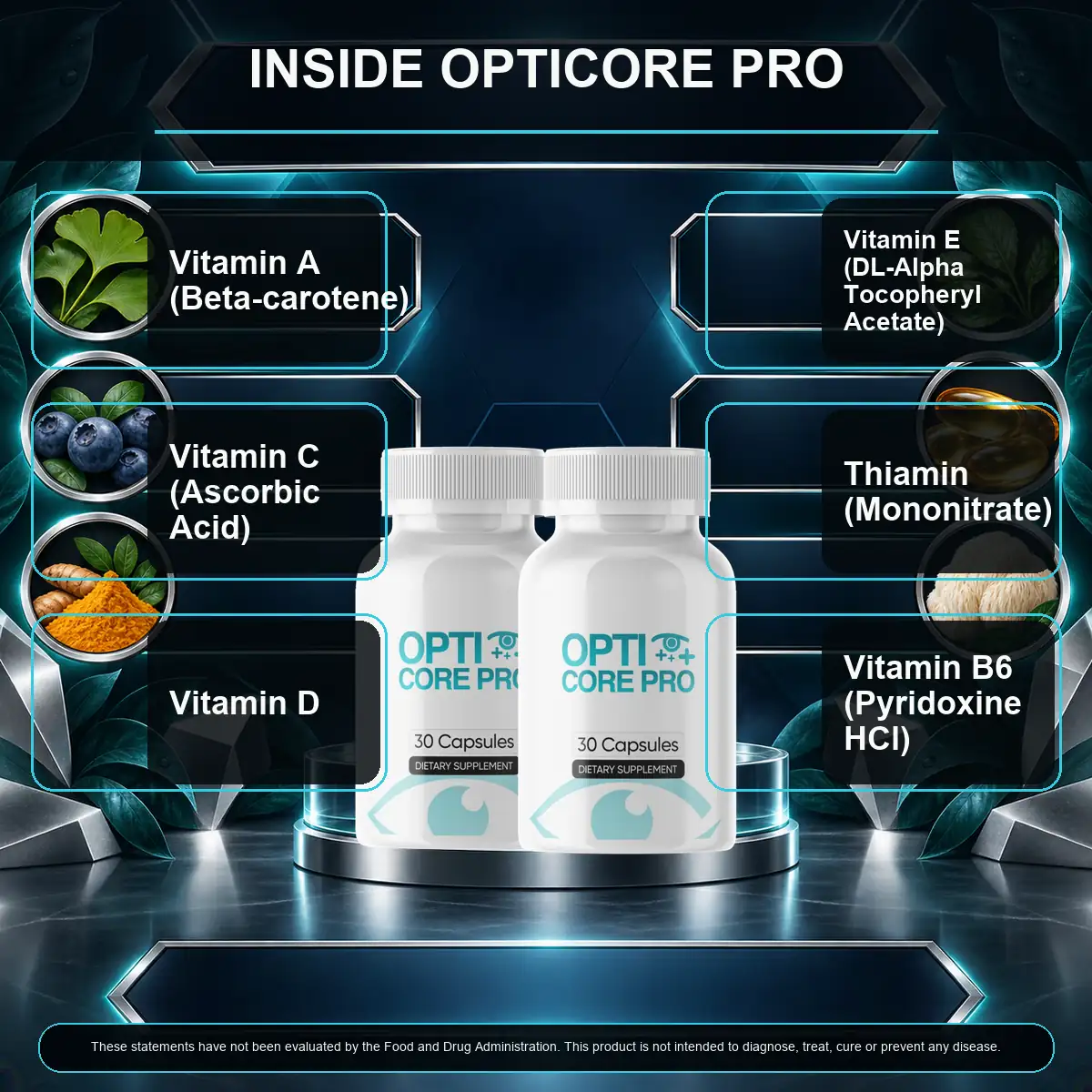
The seller's product scene names six of them: vitamin a (beta-carotene), vitamin c (ascorbic acid), vitamin d, vitamin e (dl-alpha tocopheryl acetate), thiamin (mononitrate) and vitamin B6. The bottle in the same picture prints sixteen plus the blend.
Where a marketing graphic and a Supplement Facts panel disagree, the panel is the one with a regulatory definition behind it, and the panel is what this page uses. The full row-by-row transcription, including the %DV column and the footnote, is on the supplement facts page.
The OptiCore Pro vitamins, one row at a time
Ten rows carrying a vitamin, each with the amount the published work used beside it.
Vitamin C
as ascorbic acid60 mg · 66.5% DVThe biggest vitamin weight on the panel, and the one row that appears in both landmark eye trials, so it is the easiest to place. A whole orange carries roughly this much. The connective tissue of the cornea and the lens both use ascorbate, and the aqueous humour holds it at many times the concentration of blood.
The trial figure is the part worth holding on to: AREDS gave 500 mg a day for more than six years, and AREDS2 left that amount alone when it revised everything around it. Sixty milligrams is a dietary top-up at roughly an eighth of it.
Vitamin E
as DL-alpha tocopheryl acetate7 mg · 46.5% DVThe synthetic form, which is what the DL prefix means, and the same family AREDS used. It is fat-soluble, so it wants a meal with some fat in it, which sits oddly against the label's own instruction to take the capsule twenty to thirty minutes before eating.
AREDS gave 400 IU a day, near 268 mg of this same synthetic tocopherol, which is close to forty times the amount here. The high end of that range has its own literature: the SELECT trial ran 400 IU a day in 35,533 men and reported more prostate cancer in the vitamin E arm, which is an argument for a modest figure rather than against one.
Vitamin A
as beta-carotene60 mcg RAE · 6.5% DVDeclared as retinol activity equivalents rather than as a weight of beta-carotene, which is the modern convention and the reason this row looks so small next to the trials. Vitamin A is the one nutrient with an unarguable role in sight: it becomes retinal, the molecule the rods use in dim light.
AREDS gave 15 mg of beta-carotene. Two large trials are the reason nobody gives that much any more. ATBC ran 20 mg a day in male smokers and found more lung cancer in the beta-carotene arm; CARET ran 30 mg with retinyl palmitate and was stopped twenty-one months early for the same signal, which its own risk-factor analysis sets out. A 2022 meta-analysis reached the same place. At 60 mcg RAE this row is nowhere near any of it.
Vitamin D
as cholecalciferol10 mcg · 50% DVFour hundred international units, the amount that goes into most multivitamins. D3 rather than D2, which is the better-absorbed of the two. Its eye evidence is thin rather than absent.
The VITAL eye study followed 25,871 people for a median of 5.3 years on 2,000 IU a day, five times this amount, and reported no effect on macular degeneration risk. That is a useful null: it means nobody should buy a capsule for the vitamin D in it, at this amount or at five times it.
Biotin
vitamin B72,500 mcg · 8,333.5% DVThe largest figure on the panel by a factor of thirty, and the row that says the most about which shelf this formula was drawn from. Two and a half milligrams of biotin is the standard dose in a hair and nail capsule, and the review of that literature found eighteen reported cases in total, every one in somebody with an underlying cause of poor growth.
No trial has measured a vision outcome for biotin at any amount. What this row does have is a laboratory consequence, and it is specific: biotin at supplement doses binds the streptavidin used in routine immunoassays. A 2025 survey covers the scale of it, there is a published thyroid panel read wrongly because of it, and a troponin risk assessment puts numbers on the worst case. Say what you take before a blood test and follow the laboratory's advice on pausing.
Thiamin
as thiamin mononitrate3 mg · 250% DVVitamin B1, at two and a half times a Daily Value that is itself set at 1.2 mg. Thiamin is water-soluble and has no upper intake level, so this is a large multiple of a small number rather than a large dose.
Its retinal literature is observational: a 2020 study measured blood thiamine pyrophosphate against the stage of diabetic retinopathy and found lower concentrations at later stages. That is an association in people with diabetes, not a trial of a capsule in people without it.
Vitamin B6
as pyridoxine hydrochloride4 mg · 235.5% DVThe row where the form and the amount are both worth reading. Pyridoxine HCl is the cheap synthetic form, and B6 is the one B vitamin with a well-described toxicity: sensory neuropathy, which a 2021 review traces to dose and duration together.
Those cases sit at tens to hundreds of milligrams a day sustained over months. Four milligrams is far below that range, and the reason to know the number is arithmetic rather than alarm: a B-complex taken alongside this capsule adds to it.
Folate
440 mcg folic acid748 mcg DFE · 187% DVDeclared in dietary folate equivalents, which is why the printed figure is larger than the weight of folic acid it comes from. Synthetic folic acid is counted at 1.7 times the weight of food folate, and 440 times 1.7 is 748, so this panel's arithmetic is internally correct.
The eye trial that used this combination is WAFACS: folic acid 2,500 mcg, pyridoxine 50 mg and cyanocobalamin 1,000 mcg together in 5,205 women over 7.3 years, with a relative risk of 0.66 for macular degeneration. All three amounts are several times what this capsule carries, and that trial has never been repeated.
Vitamin B12
as cyanocobalamin6 mcg · 250% DVCyanocobalamin is the stable synthetic form used in almost every supplement and fortified food. Six micrograms is two and a half Daily Values, which for B12 is an ordinary supplemental amount rather than a high one.
The same WAFACS arm above used 1,000 mcg, about 167 times this. B12 has no upper intake level because absorption is capped by intrinsic factor, so the practical argument for reading this row is that anyone taking a separate B12 tablet already has this covered several times over.
Pantothenic acid
as D-calcium pantothenate15 mg · 300% DVVitamin B5, three Daily Values, and the row with the least to say for itself in an eye context. It sits in almost every multivitamin at about this amount because it is cheap, stable and has no meaningful upper limit.
There is no vision trial of pantothenic acid. It is on the panel for the same reason it is on a hundred other panels, which is completeness of the B group rather than a finding anybody can point at.
The OptiCore Pro minerals, one row at a time
Six minerals, and two of them are worth adding to whatever else you already take.
Zinc
as zinc oxide3.62 mg · 33% DVThe mineral with the strongest claim to an eye role. Zinc concentrates in the retina and the choroid, and it is the ingredient AREDS singled out for its own report. The form here is zinc oxide, the same salt the trial used, so the comparison is clean.
The amounts are not. The AREDS zinc analysis followed 80 mg a day over five years and measured what it did to serum zinc and to haematocrit. AREDS2 then tested 25 mg against 80 mg and found the lower amount performed as well, which is the more useful number for reading a label like this one. At 3.62 mg this row is about a seventh of even the low arm. It also explains why no copper appears here: the trials added 2 mg of copper because sustained high-dose zinc depletes it, an effect tracked in pharmacovigilance data, and that problem does not arise at this amount.
Magnesium
as magnesium oxide60 mg · 14.5% DVThe form is the story in this row. Magnesium oxide is the cheapest salt and carries the most elemental magnesium per milligram of raw material, which is why it is the one a small capsule reaches for.
It is also the least absorbed. A crossover comparison measured magnesium oxide against magnesium citrate and found citrate absorbed measurably better. Sixty milligrams of the oxide is therefore a smaller delivered amount than the figure suggests, and the panel is right to print 14.5% rather than anything larger.
Iron
as ferrous fumarate7.25 mg · 40.5% DVThe row most worth noticing before you buy, because iron is the one ingredient here that a person can accumulate. Ferrous fumarate is a well-absorbed organic salt and 7.25 mg is a real supplemental dose rather than a token one.
Its eye evidence runs the other way from most of the panel: a population study of serum ferritin looked at iron status against macular degeneration and found the association in the direction of more iron, not less. Anyone already on a prescribed iron tablet, and anyone with haemochromatosis in the family, has a genuine reason to add this figure to what they already take.
Calcium
as calcium carbonate40 mg · 3% DVForty milligrams is a rounding error against a 1,300 mg Daily Value, and calcium carbonate in a capsule this size is usually there as much for bulk and flow as for nutrition.
It earns a mention because AREDS Report 39 examined dietary and supplementary calcium against macular degeneration in the trial's own cohort. That report is the reason the row is worth reading rather than skipping; at 3% of a Daily Value it changes nobody's total.
Manganese
as an amino acid chelate2 mg · 87% DVA chelated form, which is the better-absorbed end of the manganese market, at almost a full Daily Value. Manganese is a cofactor for the superoxide dismutase inside mitochondria, which is the antioxidant argument for putting it here.
It is also the one trace mineral on this panel with a neurological ceiling. A 2025 review covers what excess manganese does and who is vulnerable, chiefly people with impaired liver clearance. Two milligrams a day from a capsule is an ordinary amount; two milligrams from this plus two more from a separate multivitamin is a total worth knowing about.
Potassium
as potassium gluconate47 mg · 1% DVOne per cent of a Daily Value set at 4,700 mg, and the smallest contribution on the panel in proportional terms. A medium banana carries roughly nine times this.
Capsule potassium is capped by regulation rather than by formulation, which is why every supplement on the shelf carries a similarly small figure. It is honest of the panel to print the 1% rather than to lead with the milligrams.
The eleven botanicals in the OptiCore Pro proprietary blend
What a blend total can tell you, and where it stops.
A proprietary blend is a legal shape, not a secret. A manufacturer may declare the total weight of a mixture and list its parts in descending order without giving a figure for any one of them. That is what the last row of this panel does: 179.5 mg across the eleven plants below, in the order the label sets them.
The order carries real information. PABA leads, so it outweighs the ten beneath it, and barley grass is last. Beyond that ranking nobody outside the factory can say whether the split is 90 mg and ten crumbs or eleven portions of roughly 16 mg.
| Botanical | As the label names it | Where its human research sits |
|---|---|---|
| P-amino benzoic acid (PABA) | — | Used in gram quantities in the old Peyronie's disease trials. Its one published liver-injury case report arrived at that scale. |
| Horsetail | Equisetum arvense L., whole plant | Reaches supplements through the silica argument. The literature that returns for it is toxicological: a safety assessment of the same plant in cosmetic use. |
| Fo-Ti | Polygonum multiflorum, root | The one botanical here with a documented human signal, and it is a liver signal. A case-control cohort and a causality analysis both describe herb-induced liver injury attributed to it. |
| Bamboo extract | Phyllostachys nigra, leaf | Another silica source. No human trial of bamboo leaf came back from PubMed for this review, so nothing is quoted for it. |
| Stinging nettle | Urtica dioica L. | Its human work is urological and uses the root: a randomised trial gave 450 mg a day for twelve weeks, more nettle alone than this whole blend weighs. |
| Chinese peony | Paeonia lactiflora, root | A large traditional pharmacology, summarised in a 2024 review, none of it measuring an eye outcome. |
| Spirulina | Arthrospira platensis, whole plant | A blue-green alga carrying carotenoids. Its best-supported human finding is inflammatory: a meta-analysis of its effect on C-reactive protein. |
| Saw palmetto | Serenoa repens | A prostate and hair botanical. The two-year hair comparison used 320 mg a day on its own, again more than the blend's entire weight. |
| Plant sterols | from soy bean, Glycine max | The cholesterol literature works at roughly 2 g a day, per a 2023 meta-analysis. This is also why the allergen line reads as it does. |
| Alfalfa | Medicago sativa, herb | Carries L-canavanine, the amino acid behind the 1982 primate work on a lupus-like syndrome. Relevant to anyone with an autoimmune diagnosis. |
| Barley grass | Hordeum vulgare L., whole herb | A greens-powder ingredient. As with bamboo leaf, no human trial returned for it in this review and none is quoted. |
Every entry above is a safety record or a record of the amount a trial needed. None of the eleven has a published trial measuring a vision outcome, and none is cited here as if it did.
Two of the eleven have well-known single-plant trials. Nettle root ran at 450 mg a day and saw palmetto at 320 mg a day. Either figure on its own is larger than the 179.5 mg this blend gives to all eleven together.
Reading the OptiCore Pro amounts against the eye trials
One table, once, in the section whose job it is.
This is the one section on this page that sets the label beside the research column by column, and the reason it is only here is that a comparison repeated in every section stops being a comparison and becomes a mood.
Two trials define this whole category. AREDS gave vitamin C 500 mg, vitamin E 400 IU, beta-carotene 15 mg, zinc 80 mg and copper 2 mg to people with established macular disease. AREDS2 swapped the beta-carotene for lutein 10 mg and zeaxanthin 2 mg, tested omega-3 alongside, and tried zinc at 25 mg. The National Eye Institute prints both formulations ingredient by ingredient.
Read down the middle column and the shape of this bottle appears. Four nutrients overlap with the trials at a fraction of their amounts; the three ingredients AREDS2 is known for are absent from this panel altogether; and the largest weight in the capsule belongs to a nutrient with no eye trial at all.
The honest conclusion is narrow rather than damning. A daily multivitamin aimed at the eye is a reasonable thing to sell and a reasonable thing to buy. It is not the AREDS2 formulation, nobody should describe it as one, and the 2023 Cochrane review is the place to read what the real formulation did and did not achieve.
The other ingredients on the OptiCore Pro label
Four inactive ingredients, one shell and one allergen.
Below the panel every supplement prints the parts that carry no nutritional claim: the shell, the fillers and the flow agents. Four appear here, and the allergen line underneath them matters more than any of the four.
| What it is | Why it is in the capsule |
|---|---|
| Rice flour | Bulking agent. Fills the shell so a small active weight can be pressed and handled consistently. |
| Hypromellose | The capsule shell itself, made from modified cellulose. This is a vegetable capsule rather than a gelatin one, which makes the product suitable for vegetarians. |
| Magnesium stearate (vegetable) | Flow agent. Stops powder sticking to the tooling during filling. |
| Silicon dioxide | Anti-caking agent, in a quantity measured in fractions of a milligram. |
The label reads “Contains: Soy”. The blend also carries plant sterols from soy bean, so soy reaches this capsule twice over. Anyone with a soy allergy should treat OptiCore Pro as unsuitable rather than assume the amount is too small to matter.
Storage is printed on the bottle as well: store in a cool, dry place away from heat and light, which for a capsule holding beta-carotene and a tocopherol is a real instruction rather than boilerplate. A bathroom windowsill is the worst place in the house for it.
OptiCore Pro ingredient questions
Does OptiCore Pro contain lutein or zeaxanthin?
No. Neither appears on the panel. They are the two carotenoids AREDS2 added, at 10 mg and 2 mg a day, and they are the reason a buyer expecting an AREDS2-style formula should read the panel before ordering. This capsule is a broad multivitamin with a botanical blend, built on a different idea.
Why is there no copper in OptiCore Pro?
Because there is no high-dose zinc for it to offset. AREDS added 2 mg of copper specifically to protect against the copper depletion that follows sustained 80 mg zinc intake. At 3.62 mg of zinc that question never arises, so the absence here is internally consistent rather than an oversight.
How much of each herb is in the OptiCore Pro blend?
The label gives one figure for all eleven, 179.5 mg, and lists them in descending order of weight. PABA is therefore the largest and barley grass the smallest. No further split exists on the artwork, and this desk does not estimate one.
Is OptiCore Pro suitable for vegetarians?
The shell is hypromellose, a plant-derived cellulose, so the capsule itself is not an animal product. The panel names nothing animal-derived either. The soy line is the constraint that catches more people than the vegetarian question does.
Does OptiCore Pro contain caffeine or any stimulant?
No. Nothing on the panel is a stimulant, and nothing in the blend is a source of caffeine. It is a once-daily multivitamin with a botanical blend, and it will not affect sleep in the way a pre-workout or a fat burner would.
Which single ingredient is the largest in OptiCore Pro?
By weight of a declared nutrient, biotin at 2,500 mcg. By weight overall, the 179.5 mg blend, though that figure covers eleven plants rather than one. In proportional terms biotin is far ahead of everything else at 8,333.5% of its Daily Value.
Sources for the OptiCore Pro ingredient amounts
Each study named above, in the order the panel lists the row it belongs to.
- Age-Related Eye Disease Study Research Group. A randomized, placebo-controlled, clinical trial of high-dose supplementation with vitamins C and E, beta carotene, and zinc for age-related macular degeneration and vision loss: AREDS report no. 8. Arch Ophthalmol. 2001;119(10):1417-36. PMID 11594942. https://pubmed.ncbi.nlm.nih.gov/11594942/
- Age-Related Eye Disease Study Research Group. The effect of five-year zinc supplementation on serum zinc, serum cholesterol and hematocrit in persons randomly assigned to treatment group in the age-related eye disease study: AREDS Report No. 7. J Nutr. 2002;132(4):697-702. PMID 11925463. https://pubmed.ncbi.nlm.nih.gov/11925463/
- Age-Related Eye Disease Study 2 Research Group. Lutein + zeaxanthin and omega-3 fatty acids for age-related macular degeneration: the Age-Related Eye Disease Study 2 (AREDS2) randomized clinical trial. JAMA. 2013;309(19):2005-15. PMID 23644932. https://pubmed.ncbi.nlm.nih.gov/23644932/
- Evans JR, Lawrenson JG. Antioxidant vitamin and mineral supplements for slowing the progression of age-related macular degeneration. Cochrane Database Syst Rev. 2023;9(9):CD000254. PMID 37702300. https://pubmed.ncbi.nlm.nih.gov/37702300/
- About AREDS and AREDS2. National Eye Institute, National Institutes of Health. https://www.nei.nih.gov/research/clinical-trials/age-related-eye-disease-studies-aredsareds2/about-areds-and-areds2
- Alpha-Tocopherol, Beta Carotene Cancer Prevention Study Group. The effect of vitamin E and beta carotene on the incidence of lung cancer and other cancers in male smokers. N Engl J Med. 1994;330(15):1029-35. PMID 8127329. https://pubmed.ncbi.nlm.nih.gov/8127329/
- Omenn GS, Goodman GE, Thornquist MD, Balmes J, et al. Effects of a combination of beta carotene and vitamin A on lung cancer and cardiovascular disease. N Engl J Med. 1996;334(18):1150-5. PMID 8602180. https://pubmed.ncbi.nlm.nih.gov/8602180/
- Omenn GS, Goodman GE, Thornquist MD, Balmes J, et al. Risk factors for lung cancer and for intervention effects in CARET, the Beta-Carotene and Retinol Efficacy Trial. J Natl Cancer Inst. 1996;88(21):1550-9. PMID 8901853. https://pubmed.ncbi.nlm.nih.gov/8901853/
- Kordiak J, Bielec F, Jablonski S, Pastuszak-Lewandoska D. Role of beta-carotene in lung cancer primary chemoprevention: a systematic review with meta-analysis and meta-regression. Nutrients. 2022;14(7). PMID 35405977. https://pubmed.ncbi.nlm.nih.gov/35405977/
- Klein EA, Thompson IM Jr, Tangen CM, Crowley JJ, et al. Vitamin E and the risk of prostate cancer: the Selenium and Vitamin E Cancer Prevention Trial (SELECT). JAMA. 2011;306(14):1549-56. PMID 21990298. https://pubmed.ncbi.nlm.nih.gov/21990298/
- Christen WG, Cook NR, Manson JE, Buring JE, et al. Effect of vitamin D and omega-3 fatty acid supplementation on risk of age-related macular degeneration: an ancillary study of the VITAL randomized clinical trial. JAMA Ophthalmol. 2020;138(12):1280-1289. PMID 33119047. https://pubmed.ncbi.nlm.nih.gov/33119047/
- Cinici E, Dilekmen N, Senol O, Arpali E. Blood thiamine pyrophosphate concentration and its correlation with the stage of diabetic retinopathy. Int Ophthalmol. 2020;40(12):3279-3284. PMID 32715366. https://pubmed.ncbi.nlm.nih.gov/32715366/
- Hadtstein F, Vrolijk M. Vitamin B-6-induced neuropathy: exploring the mechanisms of pyridoxine toxicity. Adv Nutr. 2021;12(5):1911-1929. PMID 33912895. https://pubmed.ncbi.nlm.nih.gov/33912895/
- Christen WG, Glynn RJ, Chew EY, Albert CM, Manson JE. Folic acid, pyridoxine, and cyanocobalamin combination treatment and age-related macular degeneration in women: the Women's Antioxidant and Folic Acid Cardiovascular Study. Arch Intern Med. 2009;169(4):335-41. PMID 19237716. https://pubmed.ncbi.nlm.nih.gov/19237716/
- Patel DP, Swink SM, Castelo-Soccio L. A review of the use of biotin for hair loss. Skin Appendage Disord. 2017;3(3):166-169. PMID 28879195. https://pubmed.ncbi.nlm.nih.gov/28879195/
- Chiu KC, Jhan JR, Yan HN, Liao YC. Biotin interference in routine clinical immunoassays. Pract Lab Med. 2025;45:e00472. PMID 40417451. https://pubmed.ncbi.nlm.nih.gov/40417451/
- Russwurm M, Wild J, Gobel J. Biotin interference in thyroid function tests. Dtsch Arztebl Int. 2025;122(20):557. PMID 41118561. https://pubmed.ncbi.nlm.nih.gov/41118561/
- Mumma B, Diercks D, Twerenbold R, Valcour A, et al. Clinical risk assessment of biotin interference with a high-sensitivity cardiac troponin T assay. Clin Chem Lab Med. 2020;58(11):1931-1940. PMID 32804676. https://pubmed.ncbi.nlm.nih.gov/32804676/
- Tisdale AK, Agron E, Sunshine SB, Clemons TE, et al. Association of dietary and supplementary calcium intake with age-related macular degeneration: Age-Related Eye Disease Study Report 39. JAMA Ophthalmol. 2019;137(5):543-550. PMID 30896764. https://pubmed.ncbi.nlm.nih.gov/30896764/
- Lindberg JS, Zobitz MM, Poindexter JR, Pak CY. Magnesium bioavailability from magnesium citrate and magnesium oxide. J Am Coll Nutr. 1990;9(1):48-55. PMID 2407766. https://pubmed.ncbi.nlm.nih.gov/2407766/
- Hiyama Y, Yamada T, Tomota E, Tomita T. Characterizing clinical patterns and associated factors of zinc-induced copper deficiency: insights from large-scale pharmacovigilance databases. Clin Nutr ESPEN. 2026;74:103368. PMID 42217623. https://pubmed.ncbi.nlm.nih.gov/42217623/
- Oh IH, Choi EY, Park JS, Lee CH. Association of serum ferritin and kidney function with age-related macular degeneration in the general population. PLoS One. 2016;11(4):e0153624. PMID 27096155. https://pubmed.ncbi.nlm.nih.gov/27096155/
- Magro G, Laterza V, Tosto F, Torrente A. Manganese neurotoxicity: a comprehensive review of pathophysiology and inherited and acquired disorders. J Xenobiot. 2025;15(2). PMID 40278159. https://pubmed.ncbi.nlm.nih.gov/40278159/
- Al Attar L, Kilgore W. Rare incidence of acute liver injury with potassium para-aminobenzoate introduction. Case Rep Gastroenterol. 2018;12(2):230-233. PMID 29928188. https://pubmed.ncbi.nlm.nih.gov/29928188/
- Johnson W, Bergfeld WF, Belsito DV, Cohen DE, et al. Safety assessment of Equisetum arvense-derived ingredients as used in cosmetics. Int J Toxicol. 2026;45(1_suppl):106S-121S. PMID 41069090. https://pubmed.ncbi.nlm.nih.gov/41069090/
- Jing J, Wang RL, Zhao XY, Zhu Y, et al. Association between the concurrence of pre-existing chronic liver disease and worse prognosis in patients with an herb - Polygonum multiflorum thunb. induced liver injury: a case-control study from a specialised liver disease center in China. BMJ Open. 2019;9(1):e023567. PMID 30782709. https://pubmed.ncbi.nlm.nih.gov/30782709/
- Wang J, Ma Z, Niu M, Zhu Y, et al. Evidence chain-based causality identification in herb-induced liver injury: exemplification of a well-known liver-restorative herb Polygonum multiflorum. Front Med. 2015;9(4):457-67. PMID 26459430. https://pubmed.ncbi.nlm.nih.gov/26459430/
- Akbar Karami A, Sheikhsoleimani M, Reza Memarzadeh M, Haddadi E, et al. Urtica dioica root extract on clinical and biochemical parameters in patients with benign prostatic hyperplasia, randomized controlled trial. Pak J Biol Sci. 2020;23(10):1338-1344. PMID 32981268. https://pubmed.ncbi.nlm.nih.gov/32981268/
- Rossi A, Mari E, Scarno M, Garelli V, et al. Comparitive effectiveness of finasteride vs Serenoa repens in male androgenetic alopecia: a two-year study. Int J Immunopathol Pharmacol. 2012;25(4):1167-73. PMID 23298508. https://pubmed.ncbi.nlm.nih.gov/23298508/
- Fontane L, Pedro-Botet J, Garcia-Ribera S, Climent E, et al. Use of phytosterol-fortified foods to improve LDL cholesterol levels: a systematic review and meta-analysis. Nutr Metab Cardiovasc Dis. 2023;33(8):1472-1480. PMID 37225641. https://pubmed.ncbi.nlm.nih.gov/37225641/
- Hariri M, Azizi-Soleiman F, Baradaran HR, Heshmati M. Spirulina supplementation can reduce serum levels of C-reactive protein: a systematic review and meta-analysis on randomized clinical trials. Int J Vitam Nutr Res. 2026;96(1). PMID 41873104. https://pubmed.ncbi.nlm.nih.gov/41873104/
- Ma W, Ren H, Meng X, Liu S, et al. A review of the ethnopharmacology, phytochemistry, pharmacology, pharmacokinetics and quality control of Paeonia lactiflora Pall. J Ethnopharmacol. 2024;335:118616. PMID 39053710. https://pubmed.ncbi.nlm.nih.gov/39053710/
- Malinow MR, Bardana EJ Jr, Pirofsky B, Craig S, et al. Systemic lupus erythematosus-like syndrome in monkeys fed alfalfa sprouts: role of a nonprotein amino acid. Science. 1982;216(4544):415-7. PMID 7071589. https://pubmed.ncbi.nlm.nih.gov/7071589/
Order OptiCore Pro with the whole panel in front of you
Sixteen printed amounts, an 179.5 mg blend of eleven plants, one capsule a day and 180 days from the date of purchase to change your mind.
Two bottles $158 · six bottles $294 · 180-day money-back guarantee
Order OptiCore Pro On The Official WebsiteOne capsule a day · 30 per bottle · lot OPT-26/TH-5176