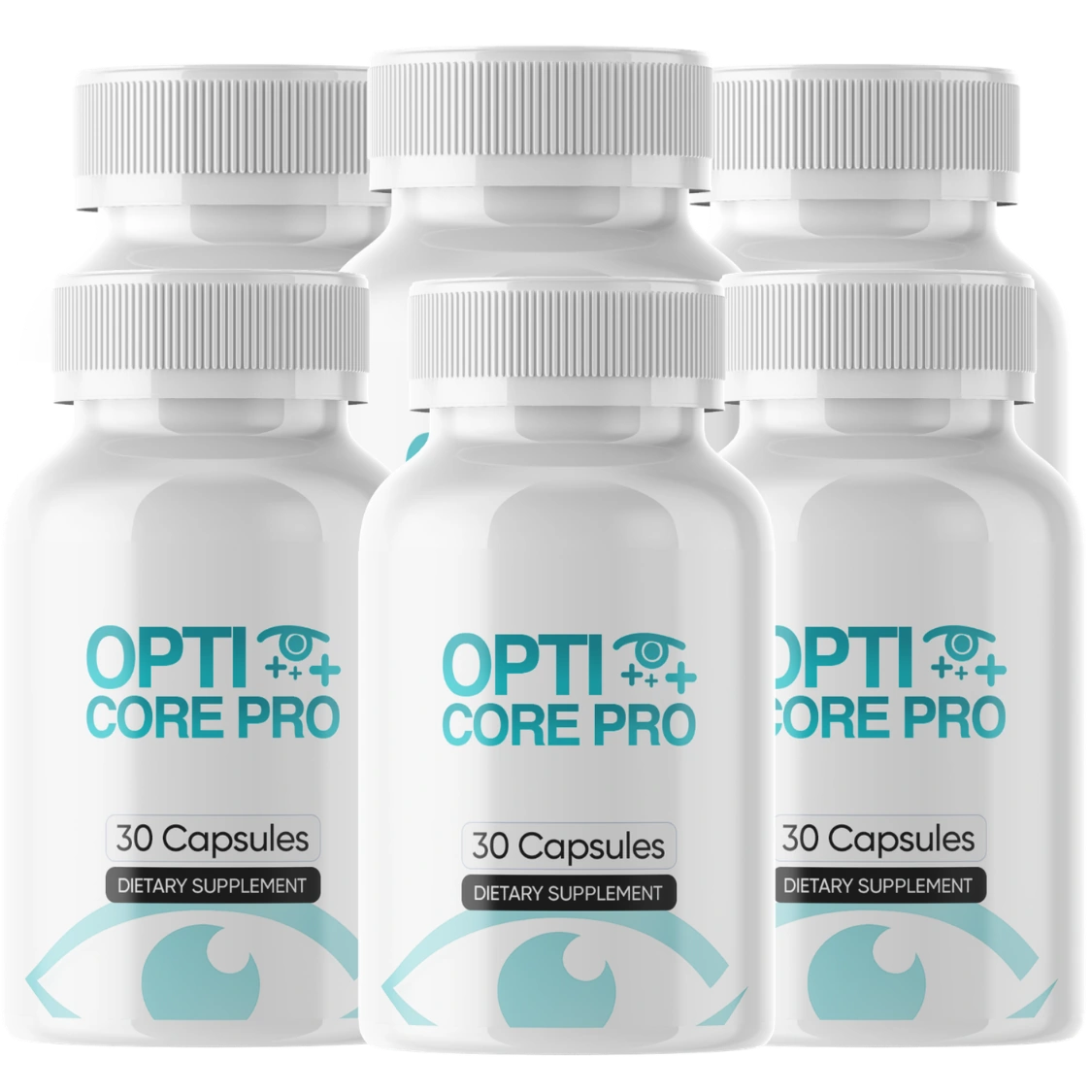
OptiCore Pro Official Website › Blog › Eye Formula Or Hair Formula
Is This An Eye Formula Or A Hair Formula?
Eight of the twenty-seven ingredients on this bottle are the standard contents of a hair and nails capsule, and the largest number on the whole panel belongs to one of them. That is not a scandal. It is a useful lesson in how to read any supplement label, and it changes what a buyer should reasonably expect.
Two shelves, two archetypes
Walk along any supplement aisle and the categories look distinct. Hair and nails on one shelf, eye health on another, joint support further down. Turn three bottles over and the panels start to blur, because a large part of the supplement market is built from the same few dozen commodity ingredients arranged into different stories.
The two archetypes below are what each category typically carries. No single bottle is exactly either of them, and setting a real panel against both is the fastest way to find out which story it is really telling.
| A hair and nails capsule | An eye formula built on the trials | |
|---|---|---|
| The headline ingredient | Biotin, usually 2,500 to 10,000 mcg | Lutein and zeaxanthin, 10 mg and 2 mg |
| The supporting vitamins | PABA, pantothenic acid, the wider B group | Vitamin C, vitamin E, sometimes beta-carotene |
| The minerals | Silica sources, zinc, iron | Zinc at 25 to 80 mg, copper at 2 mg |
| The botanicals | Horsetail, bamboo leaf, saw palmetto, nettle, Fo-Ti | Bilberry or marigold extract, if any |
| The argument | Keratin structure and follicle nutrition | Macular pigment and oxidative stress in the retina |
| The trial base | Thin. Mostly deficiency correction and case reports | Two large randomised trials in people with macular disease |
Two archetypes, drawn from what each category typically carries rather than from any one brand. Real bottles sit somewhere between them.
The right-hand column deserves one qualification before it is used as a benchmark. Those amounts come from AREDS2 and its predecessor, which were run in people who already had age-related macular degeneration. The National Eye Institute publishes both formulations ingredient by ingredient, and neither is a recommendation for somebody with healthy eyes.
Where this panel actually sits
OptiCore Pro declares sixteen nutrients with a printed weight and a per cent Daily Value, plus a 179.5 mg blend naming eleven botanicals. Sorted against the two columns above, the result is not ambiguous.
| Ingredient on this panel | Which column it belongs in | Its own trial amount |
|---|---|---|
| Biotin 2,500 mcg | Hair and nails, unambiguously | No vision trial at any amount. The hair review covers eighteen reported cases in total |
| PABA, leading the blend | Hair and nails | The old Peyronie's protocols used grams a day |
| Horsetail and bamboo leaf | Hair and nails, both as silica sources | No oral human trial returned for either |
| Saw palmetto | Hair and prostate | 320 mg a day in the two-year hair comparison |
| Stinging nettle | Prostate, using the root | 450 mg a day for twelve weeks |
| Plant sterols from soy | Cholesterol | About 2 g a day in the fortified-food literature |
| Vitamin C 60 mg | Eye, at a fraction of the amount | AREDS gave 500 mg |
| Zinc 3.62 mg | Eye, at a fraction of the amount | AREDS gave 80 mg; AREDS2 also tested 25 mg |
| Lutein and zeaxanthin | Absent | AREDS2 gave 10 mg and 2 mg |
The left column is read from the label artwork. The right column is what the published work on that ingredient used, and it is not a prediction about this capsule.
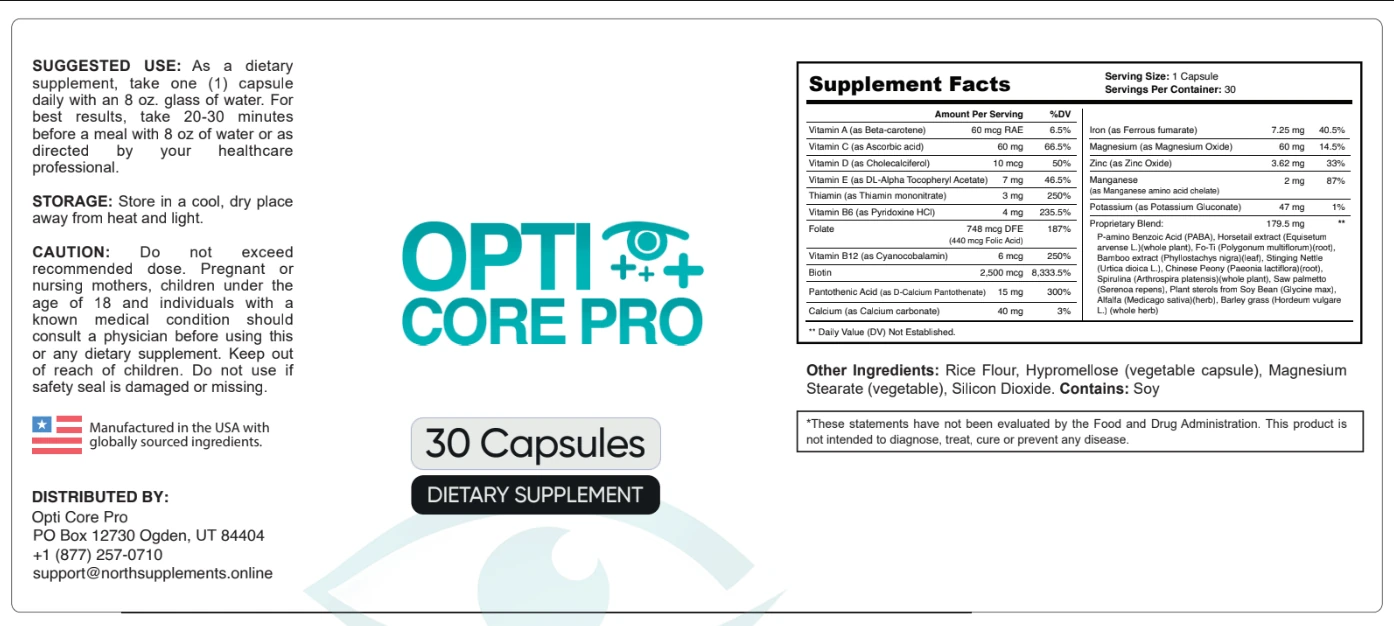
Read down that middle column and the pattern is clear. The ingredients with a real eye literature are present at a fraction of their trial amounts. The ingredients present in quantity, or present at all, mostly belong to a different shelf entirely. And the two that would settle the question in the other direction are absent.
That is a fair description of a broad multivitamin with a botanical blend, packaged and sold for the eye. It is a real product with a real use, and it is not the thing most buyers picture when they read the words on the front.
- Eight ingredients on this panel are standard hair and nails contents.
- The largest proportional figure on the label, biotin at 8,333.5% DV, is one of them.
- The two nutrients with the strongest eye-trial history are present at roughly an eighth and a twenty-second of their trial amounts.
- The two that define a modern eye formula, lutein and zeaxanthin, are absent.
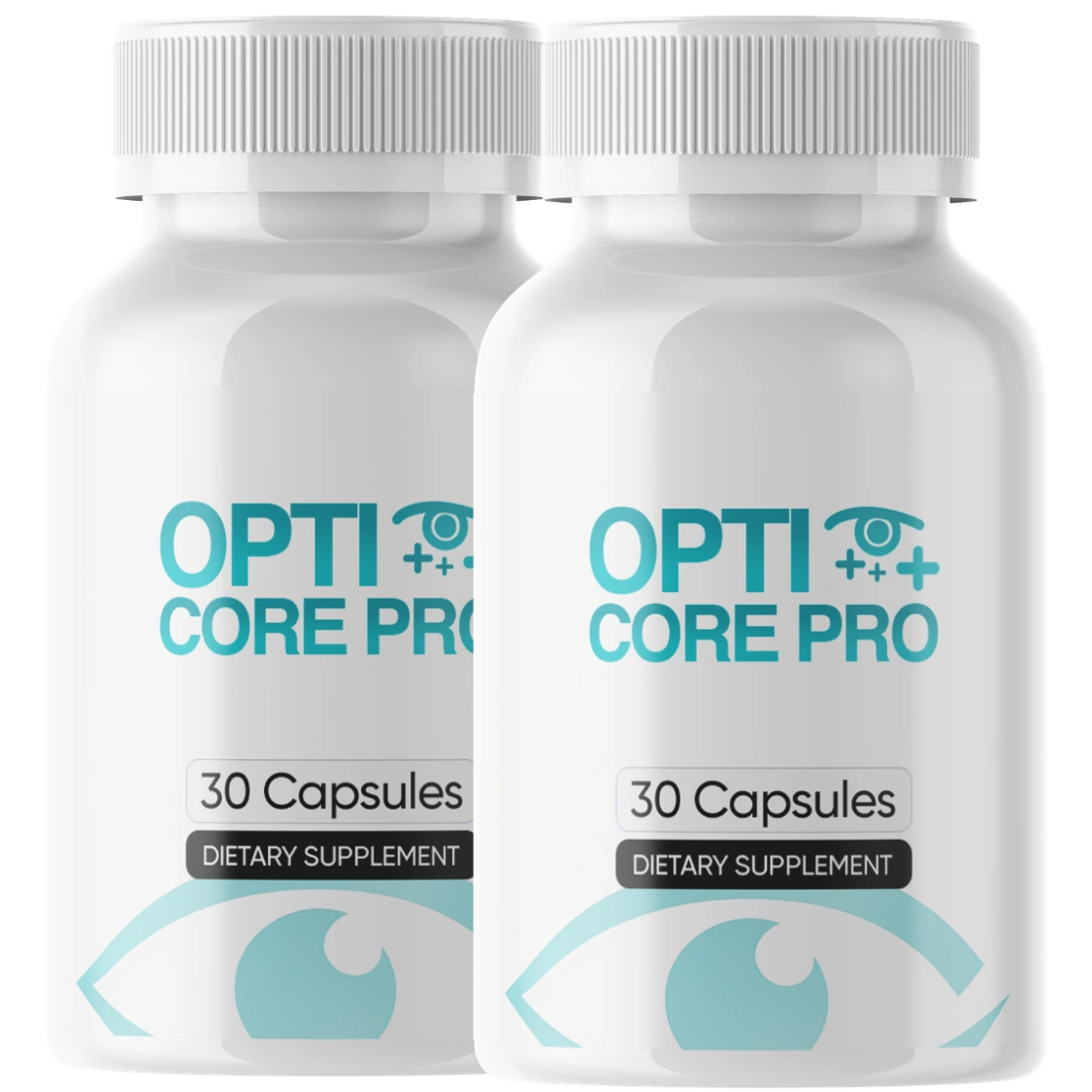
See the whole OptiCore Pro panel before deciding
Sixteen printed amounts, an 179.5 mg blend of eleven plants, one capsule a day and 180 days from the date of purchase to change your mind.
Two bottles $158 · six bottles $294 · 180-day money-back guarantee
Order OptiCore Pro On The Official WebsiteOne capsule a day · 30 per bottle · lot OPT-26/TH-5176
Why the same ingredients appear in both categories
There are three reasons, and only one of them is cynical.
The first is genuine overlap. Antioxidant nutrients act everywhere, and a vitamin that matters to the retina usually matters to the follicle too, because both are metabolically busy tissues. Vitamin C, vitamin E and zinc all appear across half the supplement market for that reason and their presence on an eye label is not suspicious.
The second reason is commercial and ordinary
Contract manufacturers hold a finite list of raw materials and a finite set of base formulas. A base carrying biotin, PABA, horsetail, bamboo and saw palmetto exists because the hair and nails category is enormous, and adapting an existing base is cheaper than formulating a new one. The result is a capsule whose backbone comes from one category and whose label comes from another.
The third is what regulation permits
A structure and function claim does not need the formula to match a trial. A bottle may say it supports eye health because its ingredients have a plausible role in ocular tissue, without any obligation to carry the amount a trial used. That is the rule for the whole industry rather than a loophole this product found, and it is why reading amounts matters more than reading claims.
The biotin figure, and what it is for
Two and a half milligrams of biotin is a specific number rather than an arbitrary one. It is the amount hair and nail capsules settled on decades ago, and it is roughly eighty-three times an adult Daily Value of 30 mcg.
The evidence behind it in its own category is thinner than the marketing suggests. A review of biotin for hair loss found eighteen reported cases in the entire literature, every one of them in somebody with an underlying cause of poor hair or nail growth. Biotin deficiency is real and correcting it works; supplementing a person who is not deficient is a different proposition.
In an eye context there is nothing at all. No trial has measured a vision outcome for biotin at any dose, and this desk searched rather than assuming.
Biotin at this amount interferes with several routine laboratory immunoassays, which is the one practical consequence of the whole figure. It has its own article on this blog and its own section on the side effects page. Tell the laboratory what you take before a blood test and the issue disappears.
The weight problem behind the blend
The eleven botanicals share 179.5 mg between them, listed in descending order with no figure for any single one. That format is legal and common, and its consequence here is arithmetic rather than legal.
Two of the eleven have well-known single-plant trials. Nettle root ran at 450 mg a day for twelve weeks. Saw palmetto ran at 320 mg a day for two years. Either figure on its own is larger than the entire blend. The plant sterols are further out still: the cholesterol literature works at roughly 2 g a day, more than eleven times the blend's whole weight.
- Eleven plants divide a total that is smaller than two of their individual trial doses.
- The descending order tells you PABA is the largest and barley grass the smallest, and nothing else.
- No plant inside the blend can be compared with a trial of that plant, because there is no figure to compare.
- Whatever the blend is doing, it is not reproducing any published single-plant result.
Three honest ways to read the result
A finding like this can be over-read in both directions, so here are the three defensible positions and what each one commits you to.
One: it is a broad multivitamin with an eye-shaped label
The most accurate description, and not a criticism. A daily multivitamin covering sixteen nutrients is a reasonable thing to take if your diet is narrow, and buying one that happens to be aimed at the eye costs nothing extra in nutritional terms. What it commits you to is dropping the expectation that it behaves like a trial formulation.
Two: the overlap is real and the framing is marketing
Also defensible. Vitamins A, C and E and zinc genuinely have roles in ocular tissue, and the label is entitled to say so. On this reading the hair-shelf ingredients are ballast rather than deception, and the question is whether you want to pay a category price for a commodity base.
Three: it is the wrong product for what you came for
If you arrived looking for the carotenoids AREDS2 is known for, this reading is the honest one. Lutein and zeaxanthin are absent, and no amount of reframing puts them on the panel. A dedicated lutein capsule costs less per day and carries the trial amounts.
Running the same check on any label
The method behind this article works on anything and takes about two minutes.
- Find the largest proportional figure on the panel, which is the row with the biggest per cent Daily Value rather than the biggest milligram weight.
- Ask which category that ingredient is famous in. If the answer is a different category from the one on the front of the bottle, you have learned something.
- Count how many named ingredients sit inside a proprietary blend and how much of the bottle's weight they share.
- Look for the two or three ingredients that define the category the label claims, and check whether they are present at all.
- Compare the amounts that are present with the trial figures for those nutrients, which is what the vision supplement guide exists to supply.
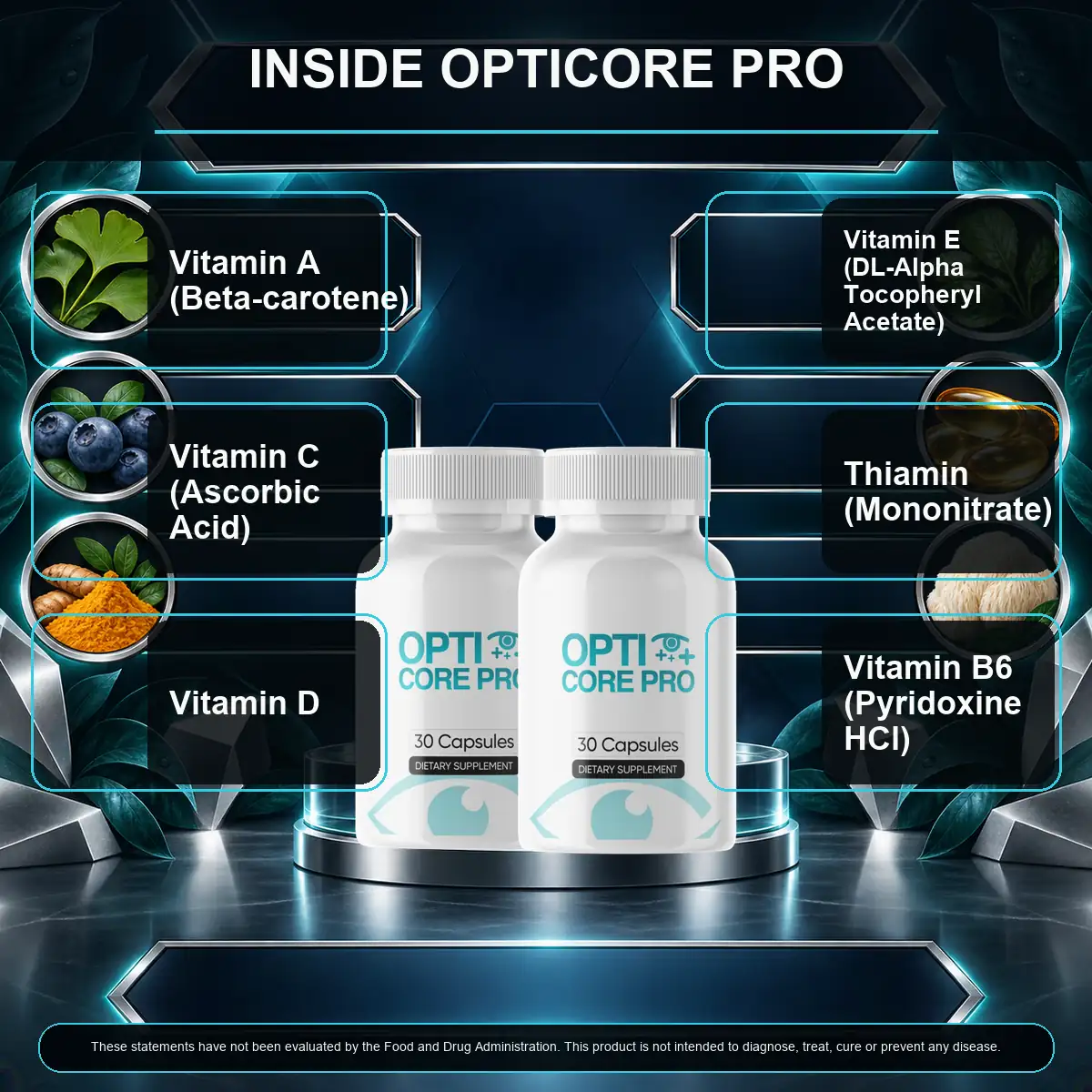
The conclusion for this particular bottle is narrow and worth stating plainly. It is a competent broad multivitamin, honestly labelled in the sense that every declared amount is printed and every percentage computes correctly. It is not an AREDS-type eye formula, nobody should describe it as one, and a buyer who understands that is buying the right thing for the right reason.
The full panel is transcribed on the supplement facts page and each row is set beside its trial amount on the ingredients page.
References
- Patel DP, Swink SM, Castelo-Soccio L. A review of the use of biotin for hair loss. Skin Appendage Disord. 2017;3(3):166-169. PMID 28879195. https://pubmed.ncbi.nlm.nih.gov/28879195/
- Rossi A, Mari E, Scarno M, Garelli V, et al. Comparitive effectiveness of finasteride vs Serenoa repens in male androgenetic alopecia: a two-year study. Int J Immunopathol Pharmacol. 2012;25(4):1167-73. PMID 23298508. https://pubmed.ncbi.nlm.nih.gov/23298508/
- Akbar Karami A, Sheikhsoleimani M, Reza Memarzadeh M, Haddadi E, et al. Urtica dioica root extract on clinical and biochemical parameters in patients with benign prostatic hyperplasia, randomized controlled trial. Pak J Biol Sci. 2020;23(10):1338-1344. PMID 32981268. https://pubmed.ncbi.nlm.nih.gov/32981268/
- Fontane L, Pedro-Botet J, Garcia-Ribera S, Climent E, et al. Use of phytosterol-fortified foods to improve LDL cholesterol levels: a systematic review and meta-analysis. Nutr Metab Cardiovasc Dis. 2023;33(8):1472-1480. PMID 37225641. https://pubmed.ncbi.nlm.nih.gov/37225641/
- Age-Related Eye Disease Study 2 Research Group. Lutein + zeaxanthin and omega-3 fatty acids for age-related macular degeneration: the Age-Related Eye Disease Study 2 (AREDS2) randomized clinical trial. JAMA. 2013;309(19):2005-15. PMID 23644932. https://pubmed.ncbi.nlm.nih.gov/23644932/
- About AREDS and AREDS2. National Eye Institute, National Institutes of Health. https://www.nei.nih.gov/research/clinical-trials/age-related-eye-disease-studies-aredsareds2/about-areds-and-areds2
Order OptiCore Pro for what the panel actually is
A broad daily multivitamin built around the eye, sixteen printed amounts, and 180 days from the date of purchase to change your mind.
Two bottles $158 · six bottles $294 · 180-day money-back guarantee
Order OptiCore Pro On The Official WebsiteOne capsule a day · 30 per bottle · lot OPT-26/TH-5176