OptiCore Pro Official Website › Blog › Biotin And Your Blood Test
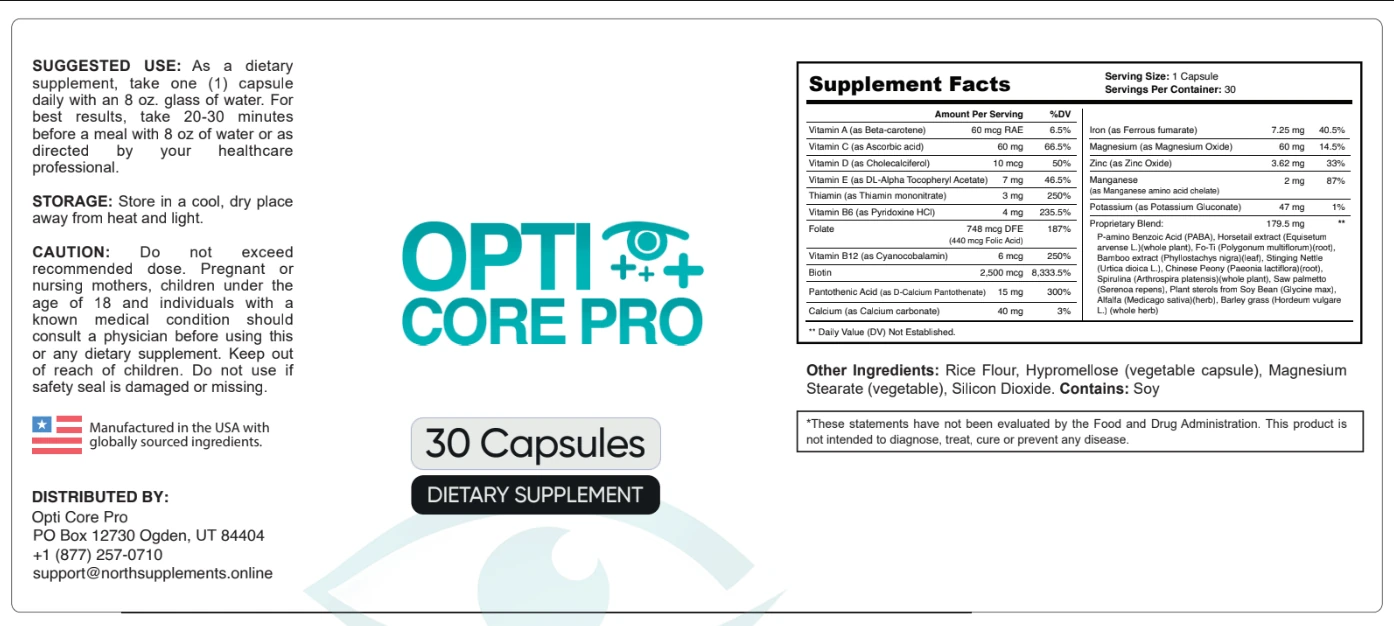
Biotin At 2,500 mcg And Your Next Blood Test
The largest number on this panel has one real-world consequence and it happens in a laboratory rather than in your body. Biotin at supplement doses interferes with a class of blood test that hospitals run every day. It is not a toxicity, it is entirely avoidable, and the fix is one sentence.
How a biotin interference actually works
A large family of laboratory tests, called immunoassays, works by catching the molecule being measured with an antibody and then capturing that antibody on a surface. A great many of them use the bond between biotin and a protein called streptavidin to do the capturing, because it is one of the strongest non-covalent bonds in biology.
That design is the whole problem. If the blood sample already contains a large amount of free biotin, it competes for the streptavidin and the capture step stops working properly.
What happens next depends on how the assay is built. In a sandwich assay the result reads falsely low. In a competitive assay it reads falsely high. The analyser reports a number with no indication that anything went wrong, which is what makes this different from an ordinary laboratory error.
A 2025 survey of biotin interference in routine clinical immunoassays sets out how widely this reaches across the tests a hospital runs in a day. It is a known, characterised problem rather than a theoretical one.
Which tests it reaches
Not everything. Chemistry panels, blood counts and clotting tests work differently and are unaffected. The tests at issue are the hormone and marker assays that use the biotin and streptavidin system.
| Test | How biotin can move it | Why it matters |
|---|---|---|
| Thyroid panel (TSH, free T4, free T3) | The commonest reported effect. Results can read as an overactive thyroid that is not there. | A published case describes exactly that, and the wrong conclusion is a treatment nobody needs. |
| High-sensitivity cardiac troponin | Can read lower than the true value on some platforms. | Troponin is used to rule a heart attack in or out, so a falsely low result is the highest-stakes version of this problem. |
| Reproductive hormones | Various, depending on the assay design. | Fertility work often involves repeated measurements, where a consistent skew is harder to spot than a one-off. |
| Vitamin D and parathyroid hormone | Can be shifted in either direction. | Both are usually measured to make a management decision rather than a diagnosis. |
| Tumour markers | Platform-dependent. | Surveillance testing depends on comparing a value with the last one, which an interference breaks. |
Which tests are affected, and in which direction, depends on the manufacturer's assay design. The laboratory running the sample knows; a website cannot.
How big the risk really is
This is where a page like this one usually stops being useful, because the honest answer is reassuring and a frightening answer is more memorable. The measured version is worth reading.
A clinical risk assessment of biotin interference with a high-sensitivity cardiac troponin assay went looking for the worst case. Interference required a blood biotin concentration above 20 ng/mL. That concentration was present in one of 797 emergency department samples. The modelled probability of a missed heart attack came out at 0.026 per cent.
That is a small number, and it is not zero. It is also entirely concentrated in people who did not mention what they take, which is the only part of the chain a patient controls.
- This is a measurement problem, not a toxicity. Biotin at this amount has no described harm.
- The tests affected are hormone and marker immunoassays, not routine chemistry or blood counts.
- The measured risk in the worst-case scenario studied was 0.026 per cent.
- All of that risk sits with people whose laboratory did not know what they were taking.
- Saying one sentence removes it.
Order OptiCore Pro with the blood-test note already made
One capsule a day, thirty to a bottle, and 180 days from the date of purchase to change your mind.
Two bottles $158 · six bottles $294 · 180-day money-back guarantee
Order OptiCore Pro On The Official WebsiteOne capsule a day · 30 per bottle · lot OPT-26/TH-5176
What to do about it, in five situations
None of this requires stopping a supplement permanently and none of it is complicated.
| Situation | What to do | Why |
|---|---|---|
| A routine blood test is booked | Tell whoever draws the blood that you take a supplement containing 2,500 mcg of biotin. | That one sentence lets the laboratory decide whether it matters for the assays it is running. |
| The laboratory asks you to pause | Pause for as long as it asks, usually a short period before the draw. | Biotin clears quickly. A pause of a day or two is enough for most platforms and the laboratory knows its own. |
| A result comes back that surprises everybody | Mention the biotin before anything is repeated or acted on. | It is cheaper to repeat a test knowing about an interference than to investigate a result that was never real. |
| You are in an emergency department with chest pain | Say it as part of your medication list. | Troponin is the test in question and the team should know what you take. |
| You take a separate hair or nail supplement too | Add the two figures together before answering the question. | Stacking two biotin products multiplies the interference without adding any benefit. |
Nothing on this list involves stopping the supplement permanently, and nothing on it is difficult. The whole problem is solved by saying one sentence out loud.
“I take a daily supplement containing 2,500 micrograms of biotin.” Said to whoever draws the blood, or written on the request form, that is the entire countermeasure. The laboratory knows its own platforms and will tell you whether and for how long to pause.
What biotin does when it is not interfering with anything
Worth a section, because an article about a nuisance can leave the impression that the nutrient itself is suspect. It is not.
Biotin is vitamin B7, a cofactor for five carboxylase enzymes involved in the metabolism of fats, carbohydrates and certain amino acids. Without it those reactions stop, which is why it is an essential nutrient rather than an optional one.
Genuine deficiency is uncommon and usually has a cause: long-term anticonvulsant use, prolonged intravenous feeding without supplementation, a rare inherited enzyme disorder, or the old curiosity of eating very large quantities of raw egg white, which contains a protein that binds biotin in the gut. In those situations correcting the shortfall works, and the effect on hair and nails can be striking.
An adult Daily Value is 30 mcg and ordinary food supplies it comfortably. Egg yolk, liver, nuts, seeds, salmon and sweet potato all carry it, and gut bacteria produce some as well. Anybody eating a mixed diet is very unlikely to be short of it.
That is the whole of the nutritional case, and it is the reason the amounts used in hair supplements sit so far above it. Eighty-three Daily Values is not the correction of a shortfall. It is a bet that more will do something in somebody who was never deficient, and the review of that literature is the place to see how little sits behind the bet.
Why there is this much biotin in an eye capsule
A fair question, and the answer is about where the formula came from rather than about the eye.
Two and a half milligrams of biotin is the standard dose in a hair and nails capsule, and it sits on this panel alongside PABA, horsetail, bamboo leaf and saw palmetto, which are the other standard contents of that category. The review of biotin for hair is worth reading for what that literature actually contains: eighteen reported cases in total, every one in somebody with an underlying cause of poor growth.
In an eye context there is nothing to report. No trial has measured a vision outcome for biotin at any amount, and that is a statement about the literature rather than about this brand. The shape of the whole panel is set out in a separate article.
Checking any label for the same thing
This is not a problem specific to one product. Biotin at a similar amount is on a large share of the hair, skin and nail market, on many multivitamins and on a good number of products sold for other purposes entirely.
- Look for biotin on the Supplement Facts panel. It is sometimes listed as vitamin B7 or vitamin H.
- Read the per cent Daily Value rather than the weight. The adult Daily Value is 30 mcg, so anything in the thousands of per cent is a supplement dose rather than a dietary one.
- Add up every product you take. Two bottles carrying biotin is a total rather than two separate small numbers.
- Tell the laboratory the total before a blood test, and follow whatever it asks.
- If a result surprises the person who ordered it, raise the biotin before anything is repeated.
NCCIH's guidance on using supplements wisely makes the same general point about telling a clinician what you take, and this is one of the clearest examples of why it is worth doing.
The full safety picture for this product, including the soy line and two blend plants with published liver reports, is on the side effects page.
References
- Chiu KC, Jhan JR, Yan HN, Liao YC. Biotin interference in routine clinical immunoassays. Pract Lab Med. 2025;45:e00472. PMID 40417451. https://pubmed.ncbi.nlm.nih.gov/40417451/
- Russwurm M, Wild J, Gobel J. Biotin interference in thyroid function tests. Dtsch Arztebl Int. 2025;122(20):557. PMID 41118561. https://pubmed.ncbi.nlm.nih.gov/41118561/
- Mumma B, Diercks D, Twerenbold R, Valcour A, et al. Clinical risk assessment of biotin interference with a high-sensitivity cardiac troponin T assay. Clin Chem Lab Med. 2020;58(11):1931-1940. PMID 32804676. https://pubmed.ncbi.nlm.nih.gov/32804676/
- Patel DP, Swink SM, Castelo-Soccio L. A review of the use of biotin for hair loss. Skin Appendage Disord. 2017;3(3):166-169. PMID 28879195. https://pubmed.ncbi.nlm.nih.gov/28879195/
- Using Dietary Supplements Wisely. National Center for Complementary and Integrative Health, National Institutes of Health. https://www.nccih.nih.gov/health/using-dietary-supplements-wisely
Order OptiCore Pro with one sentence for the laboratory
A once-daily capsule for adults, sixteen printed amounts, and 180 days from the date of purchase to change your mind.
Two bottles $158 · six bottles $294 · 180-day money-back guarantee
Order OptiCore Pro On The Official WebsiteOne capsule a day · 30 per bottle · lot OPT-26/TH-5176